
PRODUCT REVIEW
In-Depth U.S. Market Review
The BIOWIND Quiet Register Booster Fan is a specialized smart home device tackling a common U.S. residential problem: uneven heating and cooling in specific rooms. It doesn't replace your HVAC system but rather augments it, aiming to eliminate hot and cold spots by increasing the airflow from a single vent. This fan’s niche is the intelligent, targeted improvement of comfort in rooms that are too far from the furnace or AC unit, such as upstairs bedrooms or bonus rooms.
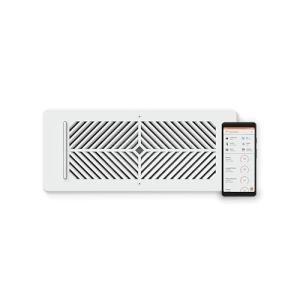
This model stands out as a strong budget-friendly register booster solution. Compared to more expensive motorized smart vents like Flair, the BIOWIND offers immediate, forced air delivery via a 10-Speed fan and a simple, integrated thermostat. You’re getting a straight-forward heating and cooling AC vent fan that focuses purely on boosting airflow, making it ideal for immediate, noticeable temperature relief rather than complex zone control.
Technical Analysis
| Specification | Detail & U.S. Context | Analysis |
| Size/Fit | Designed for 4" x 10" register holes (standard floor/wall vent size in U.S. homes). | Fits a very common U.S. duct size, ensuring broad compatibility for simple DIY installation in most rooms. |
| Airflow Control | 10 adjustable fan speeds. | Allows for precise control over the volume and noise level, a key feature for a quiet register booster fan used in bedrooms or offices. |
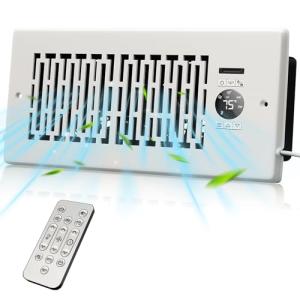
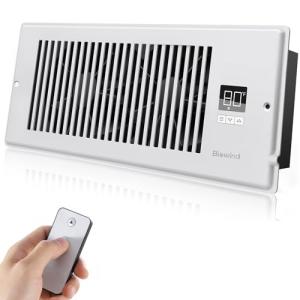
| Control Interface | Includes a wireless remote control and an integrated digital display. | Provides easy, local control of speed and temperature thresholds without needing a Wi-Fi app, appealing to users who prefer simplicity. |
| Temperature Control | Built-in thermostat and automatic mode. | The fan automatically engages and disengages based on the surrounding air temperature, improving efficiency by only running when needed. |
| Acoustics | Focus on Quiet operation. | Crucial for the U.S. market, as most installations are in bedrooms or living spaces where excess fan noise is highly disruptive. |
| Power | Standard 110V AC wall plug power (usually a small power brick). | Simple plug-and-play setup; however, it requires an outlet near the register, which is a major design consideration for U.S. homes. |
| Design | Clean, white register cover with a low-profile look. | Intended to blend discreetly into existing white trim and flooring, minimizing its visual impact in a room. |
1. Airflow Dynamics and Noise Management
The BIOWIND unit is built around dual centrifugal fans designed to pull air directly from the duct and push it into the room, overcoming common airflow resistance. The 10-speed smart heating cooling AC vent fan offers granular control, which is essential.
You can set the fan speed low for silent operation in a bedroom setting or ramp it up to maximum to quickly balance the temperature in a cold office space. This speed flexibility is key to its performance as a quiet register booster fan .
Noise reduction is a priority, as boosting fans can often be loud. The multi-speed options allow you to find the sweet spot between noticeable airflow improvement and unobtrusive operation, making it suitable for all-day home office use .
2. Thermostatic and Remote Control Operation
A key feature is the integrated thermostat control . You can set a desired temperature threshold, and the fan will only activate when the air coming from the vent meets that temperature, ensuring it’s not just blowing cold air in the winter or warm air in the summer.
The included remote control allows you to easily adjust the fan speed or the temperature setting from your couch or bed. This simple, dedicated control method is highly valued by consumers who don't want to manage another device via a smartphone app.
This dual-control approach—automatic temperature-based activation and simple manual override—makes it a very practical and user-friendly solution for immediate spot-cooling or heating needs.
3. Physical Fit and Installation Considerations
Designed for the common 4" x 10" register holes , the BIOWIND fan is a drop-in replacement for the existing vent cover. Installation is minimal: you remove the old register and plug the booster fan into a nearby wall outlet.
The need for a wall outlet nearby is a critical consideration for U.S. homeowners. While simple, it dictates where the unit can be effectively deployed. Its robust white casing is durable and designed to handle light foot traffic if installed in a floor vent.
The fan's physical dimensions ensure a clean, flush fit. The aesthetic is neutral, allowing it to easily blend into the background as an unobtrusive heating cooling AC vent fan .
User Profiles
1. The Upstairs Bedroom Sleeper
Your main bedroom or a child’s room is on the top floor, and it always seems to be 5-10 degrees warmer in the summer and colder in the winter than the rest of the house. You need immediate, targeted comfort.
-
Use Case: Before going to bed in the summer, you set the BIOWIND register booster fan to a medium speed. The integrated thermostat ensures the fan automatically starts when the AC turns on and boosts the cool air, making your bedroom noticeably comfortable for sleeping.
-
The Fit: The fan’s ability to actively pull and push air solves your immediate comfort problem. The 10-Speed Quiet feature means you can run it effectively without the distracting noise that would otherwise keep you awake.
2. The Budget-Conscious Renter
You are renting an older home or apartment and cannot make permanent changes to the HVAC system, but you need a quick, affordable fix for a single cold room. You need a plug-and-play solution.
-
Use Case: You place the fan in the floor vent of your chilly home office use space. You use the remote control to quickly set the fan to a high speed in the morning for fast warmth, then lower it for silent operation during video calls.
-
The Fit: As a self-contained, drop-in unit that simply plugs into an outlet, it requires no permanent modification or complex wiring. It's an ideal, highly effective, and portable solution for temporary comfort fixes.
3. The Basement Den Gamer
You have converted a portion of your basement into a media or gaming setup , but the low-flow vent leaves the area perpetually muggy or cold. You need an active airflow solution.
-
Use Case: You set the fan to kick on automatically when the air from the central system is 68°F or below, ensuring a steady, targeted flow of warm air during winter gaming sessions. The remote control is within easy reach on your side table for quick adjustments.
-
The Fit: The active register booster fan ensures you get the maximum amount of conditioned air into that hard-to-reach corner. Its ease of use via the dedicated remote and thermostat is perfect for quick adjustments during focused activities.
"Complementary HomeTechCorner Category Recommendations"
| Recommended Products | Why This Category Is Useful Specifically for This Product | Short Usage Scenario |
| Environmental Sensors Temp Humidity | To place a dedicated sensor further away from the vent to ensure the fan is running until the entire room reaches the desired comfort level. | You place a dedicated sensor near your bed, and you can see the true room temperature to confirm the booster fan is doing its job and you aren't just measuring the vent temperature. |
| Energy Monitoring Smart Plugs | To track the exact amount of electricity the fan is consuming, ensuring the comfort benefit is still cost-effective. | You plug the BIOWIND into an energy monitoring plug to confirm the power consumption is minimal, validating its value as an energy-efficient spot-comfort solution. |
| Smart Power Strips | To provide a safe, surge-protected outlet for the fan's power brick, especially if the outlet is in an older, less reliable location. | You plug the booster fan into a smart power strip that also protects your nearby lamp, giving you peace of mind during a summer thunderstorm. |
| Smart Vent Systems | To eventually transition to a fully automated, zone-controlled HVAC system based on the concept proved by the simple booster fan. | You've seen how effective targeted airflow is, and you start researching smart vent systems that could automate the airflow of every vent in the house for ultimate efficiency. |