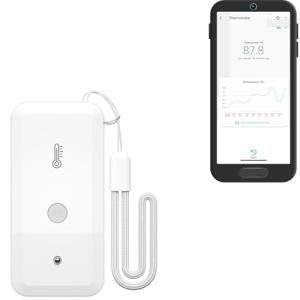
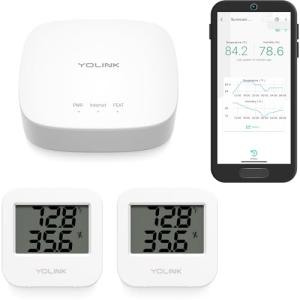
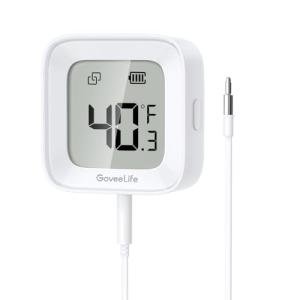
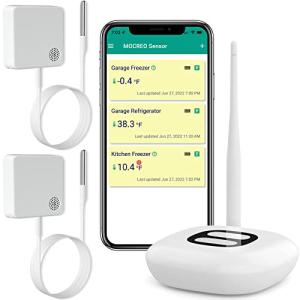
2. 🔌 Choosing Your System: Key Features and Compatibility
When selecting your Freeze/Temp Sensors , you must consider the range of temperatures you need to monitor (e.g., freezing vs. overheating) and the wireless protocol that will guarantee reliable communication from difficult, remote locations.
Essential Variations and Placement
Freeze/Temp Sensors come in a few specialized variations to address specific threats across your US home:
-
Standard Ambient Sensors (Critical Freezing/Overheating):
-
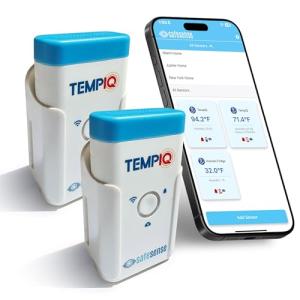
Pros: These are small, battery-powered pucks designed to measure air temperature in vulnerable, remote zones. They are excellent for monitoring areas like unfinished basements, crawlspaces, attics, or detached garages. They are the most Energy Efficiency option, offering long battery life (due to low data reporting frequency).
-
Cons: They only measure air temperature, not direct contact with pipes or water. Requires a strong mesh network signal to communicate reliably from remote locations.
-
US Lifestyle Context: Essential for monitoring the crawlspace of a home in a northern state like Michigan, providing an immediate freeze alert during a cold snap, which you can check via Remote Access .
-
Probe/Wired Tip Sensors (Direct Contact):
-
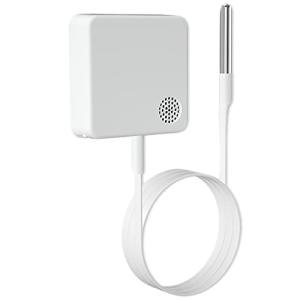
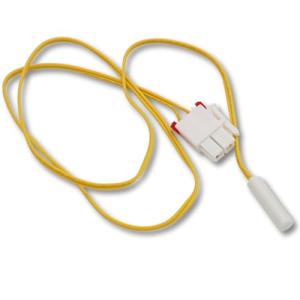
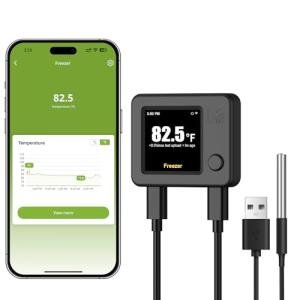
Pros: These Freeze/Temp Sensors feature a main unit (with the battery and radio) and an external probe or cable that can be placed directly against a water pipe, inside a refrigerator, or submerged in a well pump casing. This provides a more precise and immediate warning of freezing pipe temperatures.
-
Cons: Installation is slightly more complex due to cable routing. The cable itself may degrade over time in harsh environments.
-
US Lifestyle Context: Ideal for monitoring the pipe leading to an outdoor spigot in a Southern California home, where occasional freezes are unexpected but catastrophic.
-
Combination Sensors (Temp and Leak):
-
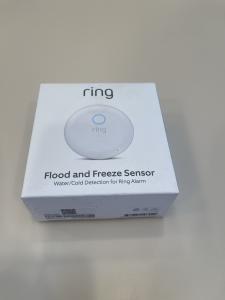
Pros: Many Freeze/Temp Sensors combine temperature monitoring with Water Leak Detectors in a single unit. This dual functionality is essential for high-risk zones (like under a water heater), providing both the freezing warning and the flood warning.
-
Cons: The combination unit is often slightly larger and may have a higher initial cost.
-
US Lifestyle Context: Best for utility closets and laundry rooms, providing layered protection against pipe bursts (freeze warning) and appliance failure (leak detection).
Compatibility Protocols
Reliable communication is paramount for Freeze/Temp Sensors , as failure to alert can lead to thousands of dollars in damage. The protocol must be low-power and long-range.
-
Z-Wave and Zigbee: These mesh protocols are the best choices for Freeze/Temp Sensors . Their low bandwidth requirements ensure maximum battery life (boosting Energy Efficiency ) and reliable signal transmission, even through floors and walls, back to the central hub for 24/7 Monitoring .
-
Wi-Fi: Wi-Fi sensors are easy to set up but are generally a less Energy Efficiency option due to high battery drain from the constant connection needed for Remote Access status updates. They are best used in plug-in models or areas very close to the router.
-
Thread and Matter: The newest protocols are ideal for Freeze/Temp Sensors because they offer standardized, highly reliable, and very low-power mesh connectivity. Matter certification ensures the sensor can trigger corrective actions (like turning on a heater) regardless of the smart plug brand.
3. 🛠️ Installation and Setup Walkthrough
Installing Freeze/Temp Sensors is simple, primarily involving quick mounting. The crucial step is accurate placement to ensure the sensor detects the danger, not just ambient air.
Pre-Installation Preparations
-
Test Location: For freeze protection, place the sensor near the lowest, most vulnerable plumbing line, often near an exterior wall or where water lines enter the home. The sensor should be placed where the cold air collects first.
-
Network Check: Ensure your Z-Wave/Zigbee mesh or Wi-Fi signal is strong enough at the installation point (crawlspace, attic). If the signal is weak, install a powered repeater (like a smart plug) nearby to ensure reliable 24/7 Monitoring .
-
Set Critical Thresholds: Before mounting, use the app to set the low-temperature alert threshold. The standard is 4 0 ∘ F ( 4 ∘ C ) to give you time to intervene before water actually freezes at 3 2 ∘ F .
Installation Guide (Typical Battery-Powered Sensor)
-
Pairing: Insert the battery and follow the hub app instructions to pair the Freeze/Temp Sensors . Name it clearly (e.g., "Crawlspace Freeze Alert").
-
Mounting: Use the included adhesive or screws to mount the sensor on an interior surface near the vulnerable area. If using a probe, route the probe cable so the tip touches the pipe or sits inside the freezer/refrigerator you are monitoring.
-
Test Temperature: Confirm the sensor is reading the temperature correctly in the app via Remote Access . You may need to wait 15 minutes for the reading to stabilize.
-
Finalize Automation: Create the "If/Then" rule: "If Crawlspace Temp drops below 40°F, THEN send critical alert AND turn on the basement heater smart plug."
Troubleshooting Common Issues
-
Issue 1: Rapid Battery Drain (Energy Efficiency failure).
-
Issue 2: Remote Access Alerts Are Delayed.
-
Issue 3: Sensor Readings Fluctuate Wildly.
-
Resolution: The sensor is placed too close to a temporary heat source (a furnace or a temporary light bulb). Reposition the sensor to measure the general ambient air in the zone, or use a probe sensor directly on the object you want to measure (e.g., a pipe).
4. Advanced Automation and Maximizing Value
The data provided by Freeze/Temp Sensors is the key input for advanced automations that actively prevent property damage and control climate systems efficiently.
Powerful Automation Scenarios
-
Proactive Freeze Prevention: The Freeze/Temp Sensors in the garage detects the temperature dropping below 4 0 ∘ F . An automation immediately turns on a space heater plugged into a Smart Wall Outlet and sends a push alert via Remote Access . The heater runs until the temperature reaches 4 5 ∘ F , preventing frozen pipes and maximizing targeted Energy Efficiency .
-
Greenhouse/Wine Cellar Climate Control: A sensor is placed in a dedicated wine cellar. If the temperature rises above 7 5 ∘ F (dangerously hot), an automation sends a critical alert and triggers a smart fan (controlled by a Smart Wall Switch ) to activate. This provides critical asset 24/7 Monitoring and climate stability.
-
Water Shutoff Integration: A Freeze/Temp Sensors in the utility room sends a low-temperature alert. An automation closes the Water Shut-Off Valves on the main line to prevent potential catastrophic pipe failure. This is the ultimate, automated property protection routine.
Longevity & Maintenance
Freeze/Temp Sensors are designed for long-term, low-maintenance operation. The biggest factor in their longevity and Energy Efficiency is battery health; consistently monitor the status via 24/7 Monitoring in the app. Always use high-quality lithium batteries, especially in cold environments, as they perform better in low temperatures than alkaline batteries. Install firmware updates promptly, as these often contain optimizations for low-temperature performance and wireless stability, ensuring reliable Remote Access and timely alerts.
5. COMPLEMENTARY CATEGORY RECOMMENDATIONS
| Recommended Categories |
Why This Category Is Useful Specifically for This Product |
Short Usage Scenario |
| Water Leak Detectors |
Often integrated with the temp sensor, or used in tandem to detect the consequence of a freeze (the pipe burst and water leak). |
The freeze sensor triggers the alarm, and the leak detector confirms the burst pipe. |
| Smart Power |
Smart plugs and outlets provide the necessary power endpoint to control heaters, fans, or other devices based on the temperature data. |
The freeze sensor detects cold and turns on a space heater plugged into a smart outlet. |
| Water Shut Off Valves |
This is the crucial actuator that automatically stops water flow to prevent flood damage upon a confirmed freeze alert. |
The sensor triggers, and the Water Shut-Off Valves closes the main line instantly. |
| Thermostats |
Sensors provide supplemental data to the main thermostat, allowing for more precise zone heating decisions to prevent freezing. |
The main thermostat raises the setpoint slightly to ensure the cold-spot sensor stays above 4 0 ∘ F . |
| Central Hubs |
The hub runs the automation logic (IF temp < 40 THEN activate power) and provides the necessary Remote Access and 24/7 Monitoring . |
The hub links the Z-Wave sensor data to a Wi-Fi smart plug for corrective action. |
| Smart Wall Switches |
Used to automate fans or lights in remote areas (like attics) to circulate air and equalize temperature, preventing hot spots or cold pockets. |
High temp in the attic triggers the smart switch for the exhaust fan. |
| Alarm Systems |
The sensor integrates with the main alarm, ensuring critical freeze alerts are handled with the same priority as security breaches. |
The freeze alert triggers the main alarm siren and sends a high-priority alert. |
| Environmental Sensors Temp Humidity |
These are often packaged together to provide comprehensive data on humidity levels, which contribute to mold or wood damage. |
The sensor reports 8 5 ∘ F and 70% humidity in the attic, triggering a ventilation routine. |
Freeze/Temp Sensors are indispensable tools for proactive property management, providing the essential, localized 24/7 Monitoring that traditional systems miss. They deliver instant alerts via Remote Access , enabling you to intervene before a pipe bursts or electronics overheat, all while supporting your Energy Efficiency by controlling localized heating and cooling only when necessary. Invest in the critical foresight of Freeze/Temp Sensors today and protect your home from invisible, costly disasters.