
PRODUCT REVIEW
In-Depth U.S. Market Review
The OSTBA 5-Tray Food Dehydrator with Timer & Temp Control is positioned squarely in the budget-friendly, entry-level segment of the U.S. dehydration market. It’s an accessible appliance that targets casual users, apartment dwellers, and those just beginning to explore the world of making homemade jerky, fruit leather, and dried herbs. Its primary niche is delivering basic functionality—temperature control and a timer—at a price point that is significantly lower than commercial or stainless steel models.
This dehydrator offers a practical budget food dehydrator for beginners experience. Compared to high-end, horizontal-flow units, the OSTBA uses a common, less-efficient vertical airflow system and plastic trays, which means you may need to rotate trays during long drying cycles. However, for its target user, it provides a cost-effective introduction to the process, making it a compelling, low-commitment choice for small-batch processing and everyday snacking.
Technical Analysis
| Specification | Detail & U.S. Context | Analysis |
| Tray Quantity/Type | 5 Stackable BPA-Free Plastic Trays | The stackable design is compact and space-saving, ideal for smaller American kitchens or apartments, though it requires manual tray rotation. |
| Power/Wattage | 240 Watts | Lower wattage compared to premium models, which is typical for a budget-friendly unit. It will require longer drying times but is highly energy-efficient for casual use. |
| Airflow System | Vertical/Bottom-Up Flow | This is the standard for basic dehydrators. The heat rises from the base, meaning the bottom trays dry faster, necessitating manual rotation for even results. |
| Temperature Control | Adjustable Knob, 95°F–158°F (approx. 3 5 ∘ C – 7 0 ∘ C ) | The temperature range is sufficient for most fruits, vegetables, and jerky. The knob control is simple and reliable, though less precise than a digital interface. |
| Timer | Up to 72 Hours | An impressive and useful feature for an entry-level model, allowing for extra-long unattended runs necessary for high-moisture foods. |
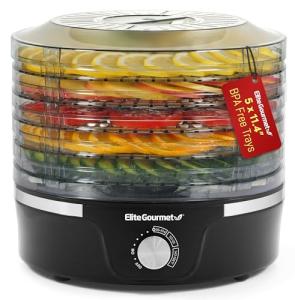
| Material | Clear Plastic Trays and Housing | Allows for easy visual monitoring of the drying process without opening the unit; the plastic is labeled BPA-free for consumer safety reassurance. |
| Overheating Protection | Integrated Overheat Safety Feature | A standard safety measure that provides peace of mind, ensuring the unit will shut down if the temperature gets too high. |
1. Airflow and Tray Configuration for Small Batches
The OSTBA 5-Tray Food Dehydrator operates with a vertical airflow, where the heat emanates from the base unit and travels upward through the five stackable trays. While this is less efficient than horizontal flow, it makes the unit very compact and easy to store, a benefit for the space-constrained urban U.S. consumer.
You should be prepared to manually rotate the stackable trays every few hours. The items closest to the heat source at the bottom will dry faster. For small, casual batches, this is a minor inconvenience, but it's a trade-off that keeps the initial cost low for this food dehydrator for beginners .
2. Control Mechanism and Timer Versatility
This model features a simple, analog knob for temperature control, offering a range from 9 5 ∘ F to 15 8 ∘ F . This is an adequate range for standard recipes, and the simplicity of the knob makes it very easy to use—perfect for a beginner who doesn't need precise digital increments.
The standout feature for a unit in this price category is the impressive 72-hour max timer. This is highly beneficial for American users who need to process very high-moisture items like thick-cut mango or make long-running fermented items. The long timer allows you to set it and leave it over a full weekend without having to manually restart the cycle.
3. Power Efficiency and Construction
Operating at a lower 240 Watts, the OSTBA 5-Tray Food Dehydrator is very energy efficient. While it requires longer drying times than a high-wattage 600W model, the low power consumption makes it economical to run for those multi-day cycles, appealing to the cost-conscious buyer.
The construction uses clear, BPA-free plastic for all five trays and the housing. The clear design allows you to easily check the progress of your drying apples or jerky without lifting the trays, thereby avoiding temperature loss and maintaining a consistent internal environment.
User Profiles
1. The Snack Experimenter
You are a student or young professional living in an apartment, interested in exploring healthier snack alternatives but on a tight budget. You are looking for a simple, space-saving, and inexpensive way to try new recipes.
-
Use Case: You want to make small batches of personalized trail mix components, like dried banana chips and sweet potato slices, without investing in a large, expensive appliance.
-
The Fit: The OSTBA is the perfect budget food dehydrator for beginners . Its compact size fits neatly on a small counter, and the low price point minimizes your commitment. The straightforward dial controls make it easy to follow basic recipes and master the fundamentals of dehydration.
2. The Herb and Spice Enthusiast
You have a small indoor herb garden or buy herbs in bulk and need an efficient, cost-effective way to dry them quickly for preservation, primarily using the lower end of the temperature spectrum.
-
Use Case: You harvest large batches of basil, oregano, and thyme from your window garden, needing to dry them quickly and cleanly to prevent mold and ensure long-term freshness for your cooking.
-
The Fit: The 9 5 ∘ F low-temperature setting is ideal for preserving the delicate flavors and colors of your herbs without cooking them. While tray rotation is needed, the five trays offer more than enough space for your weekly herb harvest, making this appliance a functional home office use solution for herb preservation.
3. The Power-Saving Prepper
Your priority is low energy consumption over speed, as you plan to run the dehydrator for extremely long periods to process large amounts of high-moisture fruits. You appreciate the peace of mind of a long-running timer.
-
Use Case: You are drying thick-cut kiwis or pineapples for a very chewy texture, which can take 30–50 hours, and you want to keep the electricity bill low.
-
The Fit: The 240W low-power operation is significantly more energy-efficient than high-wattage competitors over a long period. Furthermore, the 72-hour timer allows you to start your batch before a long weekend and trust that the machine will run the full course without needing your constant attention or manual restart.
"Complementary HomeTechCorner Category Recommendations"
| Recommended Products | Why This Category Is Useful Specifically for This Product | Short Usage Scenario |
| Kitchen Scales | To ensure you precisely slice your fruit and vegetables to a uniform thickness, essential for consistent drying in a vertical-flow unit. | You weigh your potato slices to guarantee they are all exactly 1/8-inch thick, compensating for the vertical air flow to prevent over-drying the bottom trays. |
| Smart Wall Outlets | To put the dehydrator on a precise schedule and monitor the actual power consumption of the 240W motor. | You check the app on your phone and see that the low-wattage dehydrator has only used 2 kWh during its 12-hour run, confirming its energy efficiency. |
| Smart Planners Calendars | To set reminders to rotate the stackable trays every 3 to 4 hours to ensure a uniform drying result. | You set an alarm for 3 hours from now on your smart planner to remind you to shuffle the trays before the bottom layer of jerky gets too brittle. |
| Mixing Prep Tools | For easy dipping and coating of fruits and vegetables in lemon juice or other pre-treatment solutions before drying. | You use a large mixing bowl and silicone tongs to lightly coat your apple slices in a cinnamon/sugar mix before laying them on the five trays. |
| Food Thermometers | For a quick, accurate check of the internal temperature, especially if you are using the unit in a cool basement or garage, to ensure the heat is stable. | You quickly open the door and use the thermometer to confirm the air temp inside the unit is exactly 13 5 ∘ F , not fluctuating due to the ambient room temperature. |