
PRODUCT REVIEW
In-Depth U.S. Market Review
The Elite Gourmet Food Dehydrator with 5 Trays is an ultra-budget-friendly appliance that captures the very entry level of the U.S. food preservation market. It's designed for the highly casual user, the student, or anyone who wants to experiment with drying small amounts of herbs or fruit without a significant financial investment or a complex appliance. Its primary niche is a simple, no-frills, compact budget dehydrator for sporadic or small-batch use.
This model makes the inevitable trade-offs for its low price point. Compared to mid-range and premium models, you get a much lower power rating (only 200W) and a highly vertical, stackable airflow system, which necessitates manual tray rotation for even drying. However, for an American consumer who just wants to dry a handful of herbs from the garden or make a single batch of beef jerky, this simplicity and low cost make the Elite Gourmet a perfectly adequate and accessible solution.
Technical Analysis
| Specification | Detail & U.S. Context | Analysis |
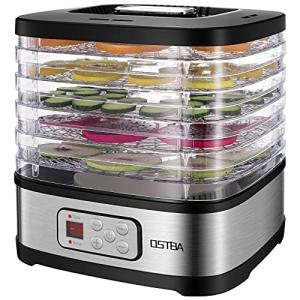
| Tray Quantity/Type | 5 Stackable Clear Plastic Trays | Compact footprint is excellent for small apartments or dorm rooms, but the design requires the user to manually rotate and flip the trays for even results. |
| Power/Wattage | 200 Watts | Very low wattage means extremely low energy consumption but also significantly longer drying times compared to 500W+ models. |
| Airflow System | Vertical Airflow, Bottom-Mounted Heater | Heat rises from the base, which will dry the bottom trays much faster than the top ones. This is typical for a budget unit and dictates the need for tray rotation. |
| Temperature Control | Simple On/Off Switch (Fixed Temp) | The most basic functionality; it operates at a fixed temperature, removing any complex setting decisions, perfect for a novice user. |
| Capacity | Small Batch Focused | Ideal for small quantities of sliced fruits or a few pounds of herbs, aligning with the needs of a single user or small household. |
| Construction | Plastic Housing and Trays | Lightweight, easy to store, and generally inexpensive to manufacture, contributing to the very low retail price. |
| Display | None (Indicator Light Only) | A simple light tells you if the unit is on or off; reliance is purely on the user's external timer and experience. |
1. Fundamental Airflow and Power Constraint
The Elite Gourmet Food Dehydrator operates on a simple principle: a bottom-mounted 200W heating element and fan push air vertically through the five trays. This minimal 200W power rating is highly energy-efficient, which is appealing to cost-conscious American consumers, but it results in substantially longer drying cycles.
Due to the vertical air flow, the trays closest to the bottom unit will dry much quicker than the ones on top. This is a design trade-off for the low price; if you use this appliance, you must remember to rotate the stack of trays frequently—perhaps every 2–3 hours—to prevent the bottom layer from over-drying or burning.
2. Control Simplicity and User Interface
In the spirit of a compact budget dehydrator , this model foregoes any digital screens, timers, or adjustable temperature controls. It features only an On/Off switch, meaning the temperature is fixed, likely around the typical range for safe food drying.
This extreme simplicity is actually a benefit for the absolute beginner. You don't have to worry about complex settings. You plug it in, flip the switch, and you're dehydrating. However, you must rely entirely on an external kitchen timer or your phone to track the long drying time, as there is no integrated timer.
3. Small Footprint and Lightweight Design
The entire unit is housed in lightweight, stackable plastic. The trays are clear, allowing you to peek at your drying progress, which is important given the need for manual rotation. The small footprint and vertical orientation make it incredibly easy to tuck away into a cabinet or store on a small counter when not in use.
Its Elite Gourmet Food Dehydrator with 5 Trays design is consciously non-intrusive, making it suitable for the American city-dweller or student living in a confined space. It's a low-volume, high-convenience appliance built for those who only dry a handful of ingredients at a time.
User Profiles
1. The College Dorm Chef
You are a student living in a small space who wants to prepare healthy, inexpensive snacks without relying on a full kitchen setup. Price and size are the two biggest factors in your purchasing decision.
-
Use Case: You are drying a small bag of bulk-bought herbs to use in your simple cooking or making a personal stash of dehydrated apple slices for studying late at night.
-
The Fit: The Elite Gourmet Food Dehydrator is perfect because its compact, lightweight design fits easily on a small desk or counter. The low price makes it an affordable first appliance, and the simple on/off switch means you can operate it without learning complex settings, addressing your need for simple, cheap operation.
2. The Curious Beginner
You have never dehydrated food before but are interested in the concept. You want to try out a few basic recipes before committing to a larger, more expensive appliance.
-
Use Case: You want to try making one pound of beginner-level teriyaki jerky and a small batch of dried oranges to see if you enjoy the process before spending hundreds on a commercial model.
-
The Fit: As a great food dehydrator for beginners , its minimal investment cost allows you to test the waters of food preservation without financial risk. While you have to manually rotate the trays, this hands-on approach actually teaches you the fundamentals of the dehydration process before upgrading.
3. The Low-Volume Dieter
You follow a strict portion-controlled diet and need to create very small, controlled batches of custom snacks to meet your specific nutritional goals. Energy efficiency is also a plus for running it frequently.
-
Use Case: You need to dry only one tray of single-serving broccoli chips and one tray of precisely weighed beef jerky portions for your week's meal plan.
-
The Fit: The small capacity is ideal for your portion-controlled, low-volume needs, preventing you from over-producing snacks. The low 200W power consumption means you can run the unit frequently for these small batches without noticing a significant spike in your monthly utility bill.
"Complementary HomeTechCorner Category Recommendations"
| Recommended Products | Why This Category Is Useful Specifically for This Product | Short Usage Scenario |
| Smart Clock Displays | To serve as the necessary external timer for the unit, since it lacks an integrated timer. | You set a voice command timer on your smart display for 3 hours to remind you to manually rotate the trays before the bottom food over-dries. |
| Smart Wall Outlets | To act as an On/Off switch with a timer function and provide basic power monitoring. | You use the smart plug to schedule the unit to automatically shut off after your expected 10-hour dry time, adding safety since it lacks a built-in timer. |
| Kitchen Scales | For accurately weighing small batches of ingredients to ensure they are uniform, critical for even drying in a basic vertical-flow unit. | You are prepping small cuts of chicken jerky and use the scale to verify each piece is 0.5 oz for consistent, predictable drying. |
| Food Thermometers | For verifying the actual temperature in the unit's trays to ensure food safety, especially since the temperature is fixed and non-adjustable. | You open the lid and quickly check with a thermometer to confirm the fixed temperature is at least 13 5 ∘ F for safe drying of your meat product. |
| Mixing Prep Tools | For easy dipping and coating of fruits or vegetables in pre-treatment solutions to prevent browning. | Before drying your apple slices, you quickly toss them in a bowl with a lemon-water solution to keep them from turning brown during the long cycle. |