
PRODUCT REVIEW
In-Depth U.S. Market Review
The Nutrichef Electric Food Dehydrator with 5 Trays targets the U.S. consumer who wants an extremely simple, no-fuss appliance for occasional or small-batch food drying. It is positioned as an accessible, entry-level option, appealing to those who value simplicity and ease of use over advanced features like digital controls or horizontal airflow. Its main selling point is its small footprint and straightforward operation, making it a great simple food dehydrator for occasional use .
This model provides a very basic, functional dehydrating experience. Compared to more expensive digital models, this unit relies on a simple knob for temperature adjustment and a basic vertical airflow system, which is a common trade-off in the budget category. It is best suited for the user who is happy to monitor the process and rotate the stackable trays manually, making it a practical and low-cost gateway into food preservation.
Technical Analysis
| Specification | Detail & U.S. Context | Analysis |
| Capacity/Trays | 5 Stackable, Removable Trays | Vertical stacking is space-saving, a key benefit for small American kitchens, but requires the user to rotate the trays to ensure uniform drying. |
| Power/Wattage | 250 Watts | Highly energy-efficient for long runs, but the low power dictates a longer drying time compared to 500W+ high-end models. |
| Airflow System | Vertical Airflow, Bottom-Mounted | Hot air rises from the base, making the bottom trays dry quickest. The user must manually rotate the trays to prevent uneven results. |
| Temperature Control | Adjustable Knob, 10 4 ∘ F – 15 8 ∘ F (approx. 4 0 ∘ C – 7 0 ∘ C ) | Simple, analog control allows for basic temperature adjustment, which is a necessary feature for customizing drying for different foods (e.g., fruit vs. jerky). |
| Construction | Heat-Resistant, Durable Housing | Lightweight plastic construction makes it easy to move and store, which is important for an appliance intended for occasional use. |
| Ease of Cleaning | Dishwasher Safe Trays (Top Rack) | The ability to put the trays in the dishwasher is a significant convenience for the U.S. consumer and a major plus for a budget unit. |
| Operation | Ultra-Quiet Operation | A key benefit for an appliance that runs for many hours, making it less disruptive for use in open-concept homes or small apartments. |
1. Airflow System and Manual Operation
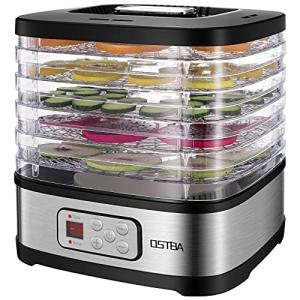
The Nutrichef Electric Food Dehydrator operates with a vertical airflow system, where the 250W heat is generated at the bottom and flows upward through the five stackable trays. This system is what keeps the unit compact and low-cost.
The main operational factor you must accept is the necessity of manual tray rotation . The lower trays will dry faster, so you must periodically rotate the stack (e.g., move the bottom tray to the top) to ensure all your food—from herbs to fruit slices—dries evenly and consistently throughout the batch.
2. Control Simplicity and Quiet Running
In line with being a simple food dehydrator for occasional use , the controls are kept basic with an analog temperature adjustment knob. This allows you to choose between a gentle, low temperature for herbs or a higher setting for safety when processing meat products. This is a reliable, easy-to-understand interface for a beginner.
A notable feature is its ultra-quiet operation. For an appliance that runs for 8 to 24 hours, the low noise level is a major selling point for users in small homes or apartments where the dehydrator may be running near a living or working space.
3. Maintenance and Material Focus
The commitment to dishwasher-safe trays is a significant advantage for the casual user. Scrubbing plastic trays can be tedious, especially after processing sticky fruit or oily marinade residue. The ability to simply load the trays into the top rack of the dishwasher saves considerable cleanup time.
The five trays are removable and extendable, allowing for some flexibility in how you load the unit, accommodating slightly bulkier items if necessary. This adds a layer of user-friendliness to the otherwise simple, compact design.
User Profiles
1. The Small-Batch Herbalist
You have a small window or porch garden and only need to dry small, weekly batches of herbs for cooking or tea. You need a compact machine that is easy to clean after use.
-
Use Case: You harvest basil, rosemary, and mint and need to dry them all at a low, consistent temperature to preserve their flavor without cooking them.
-
The Fit: The Nutrichef Electric Food Dehydrator is a perfect size for your small batches and its easy-to-use temperature dial allows you to select the precise low heat needed for delicate herbs. The dishwasher-safe trays are a huge plus for quickly cleaning the herb residue.
2. The Budget-Minded Healthy Snacker
You want to make your own healthy, additive-free snacks but are very sensitive to price and do not want a complex machine with a large learning curve. You only dry a single type of snack at a time.
-
Use Case: You are making a single, small batch of kale chips or dried strawberry slices and want a machine that is simple to set up, run, and clean.
-
The Fit: This appliance is a highly economical way to introduce homemade snacks into your diet. The low power draw keeps costs down, and the quiet operation is a benefit when running it overnight. You are willing to perform the manual tray rotation for the savings and simplicity.
3. The Preparedness Newbie
You are new to the idea of food preservation and want to practice a few basic techniques before committing to the cost and size of a high-end unit. You need a reliable, low-cost practice machine.
-
Use Case: You buy a large bag of mixed dried fruit and want to re-dry it further to ensure it's completely moisture-free for long-term storage, needing a simple, low-power machine to handle the task.
-
The Fit: The Nutrichef is an excellent choice for a trial run. Its simple operation and low initial cost minimize your financial risk. You can use it to build your confidence in basic dehydration techniques before you decide to invest in a larger, more automated best small dehydrator for beginners .
"Complementary HomeTechCorner Category Recommendations"
| Recommended Products | Why This Category Is Useful Specifically for This Product | Short Usage Scenario |
| Kitchen Scales | To help you prepare ingredients of a uniform thickness, which is a must for successful, even drying with the vertical airflow system. | You are prepping small cuts of chicken jerky and use the scale to verify each piece is 0.5 oz for consistent, predictable drying. |
| Smart Wall Outlets | To add a precise digital timer function and safely shut off the unit after your desired drying duration. | Since the unit lacks a built-in timer, you set the smart plug to cut power after 8 hours, preventing your batch of fruit from over-drying overnight. |
| Food Thermometers | For verifying the actual temperature in the unit's trays to ensure food safety, especially since the temperature is fixed and non-adjustable. | You quickly open the lid and check with a thermometer to confirm the air temp inside the unit is exactly 13 5 ∘ F , ensuring safe meat processing. |
| Smart Planners Calendars | To set a recurring reminder to manually rotate the stackable trays mid-cycle to promote consistent drying. | You set a 3-hour recurring alarm on your phone to remind you to shuffle the five trays before the bottom-layer food gets too brittle. |
| Mixing Prep Tools | For easy dipping and coating of fruits or vegetables in pre-treatment solutions or spices before you place them on the five trays. | You use a large silicone spatula to quickly toss your vegetable chips in a bowl of spices before loading them onto the trays for drying. |