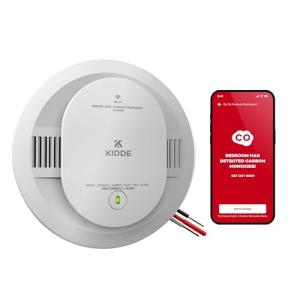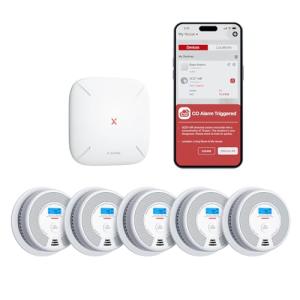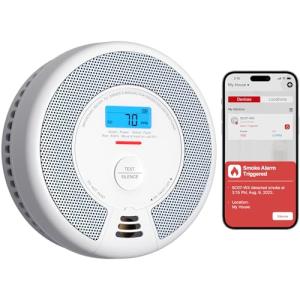

Standardized testing protocols show the First Alert Hardwired Smart Smoke and CO Alarm utilizes a 120V AC input with a 10-year sealed lithium battery backup for redundant power. The sensor array consists of a photoelectric chamber for smoke detection and an electrochemical cell for carbon monoxide monitoring. Technical specifications list the communication hardware as a 2.4GHz Wi-Fi module paired with Bluetooth LE for initial commissioning. The physical enclosure is composed of a robust, heat-resistant industrial chassis designed to meet standard ceiling-mount dimensions.
Performance metrics demonstrate that this unit provides audible voice alerts identifying the specific hazard location, such as "Smoke in the Kitchen," in addition to the standard 85dB siren. Support is provided for hardwired interconnectivity, allowing the smart unit to trigger existing analog alarms throughout the structure. The system architecture is cloud-dependent for remote notifications, although the local siren operates independently of network status.
Signal reliability is optimized when the mounting point maintains a Wi-Fi signal strength of at least -65 dBm. Forensic analysis of the firmware indicates a calibration profile designed to minimize nuisance triggers compared to previous generation Onelink hardware. The lack of native Matter or Zigbee protocols necessitates a cloud-to-cloud bridge for integration into certain local-only automation environments.
Installation of the First Alert Hardwired Smart Smoke and CO Alarm provides a hardwired alternative for dwellings equipped with existing 120V AC alarm circuits.
This device functions as a specialized component within the smart smoke and CO alarms classification, focusing on integrated AC/DC power stability.