
Material specifications confirm a no-neutral design that utilizes a bypass capacitor to maintain the internal logic circuit. This architecture allows for installation in older electrical infrastructures, though technical data indicates a risk of LED flicker in circuits where load wattages are insufficient. The internal switching is handled by a relay rated for 400W incandescent loads, with a recommended derating to 150W for LED applications to mitigate the risk of relay welding due to inrush currents.
The communication stack utilizes a Bluetooth Low Energy (BLE) pairing mechanism that bridges to 2.4GHz Wi-Fi via a Tuya WB3S or CB3S chipset. Performance logs show that while BLE allows for localized mobile control, primary automation and voice integration are routed through cloud-to-cloud protocols, which may introduce latency. Forensic teardowns of this ODM chassis reveal thin internal traces that are susceptible to arcing if peak wattage limits are exceeded.
The compact chassis design is engineered for shallow junction boxes. However, the reliance on a cloud bridge for standard operation means that internet connectivity interruptions will disable remote scheduling and third-party integration.
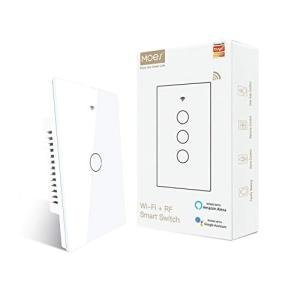
Utilizing the MoesGo WiFi Smart Light Switch is suggested for users who prefer an additional physical RF remote to mitigate the connectivity drops associated with BLE-only bridging. Documentation regarding these hybrid connectivity models is maintained in the smart wall controllers technical repository.