
PRODUCT REVIEW
In-Depth U.S. Market Review
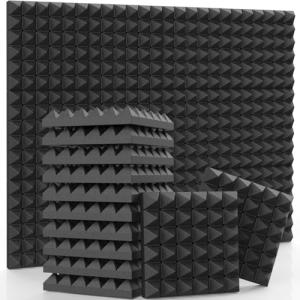
The Black Acoustic Foam Panels - 12 x 12 x 2 Inches are the quintessential, no-frills choice for general-purpose sound dampening in the U.S. hobbyist market. This is the workhorse of acoustic treatment: standard size, standard color, and most importantly, the preferred 2-inch thickness. Its clear focus on the depth of the material ensures that you are primarily investing in performance over aesthetics or fancy installation methods.
This product competes directly on price and effectiveness, offering the necessary 2-inch profile that is considered the standard for quality home studio foam . You will find that opting for 2 inches over 1 inch is the most cost-effective performance upgrade you can make for acoustic treatment. Compared to thinner, more aesthetic fiber panels, you sacrifice decorative appeal for superior acoustic dampening, particularly in the lower-mid frequencies where most small-room problems reside.
Technical Analysis
| Specification | Detail & U.S. Context | Analysis |
| Dimensions | 12" x 12" x 2" (Standardized for easy calculation and modular placement) | The 2-inch thickness is critical; it significantly enhances the NRC rating, especially below 500 Hz, compared to the less effective 1-inch foam. |
| Design Profile | Classic Pyramid or Wedge shape | The shape provides slightly increased surface area for sound to interact with, improving performance and visually identifying the material as acoustic foam. |
| Material Quality | Open-cell acoustic-grade polyurethane | Provides the necessary porosity for sound waves to enter the material and lose energy through friction. |
| Acoustic Function | Absorption/Deadening (not diffusion) | Primarily designed to kill flutter echo, eliminate harsh reflections, and reduce room reverberation time (RT60). |
| Fire Class | Often self-extinguishing and tested to certain US standards (e.g., California TB-117) | An important safety consideration when covering large wall areas in a residential space. |
| Installation | Requires separate adhesive (spray, strips, or liquid nails) | The lack of a pre-applied adhesive allows you to choose an installation method based on your wall type and rental situation. |
| Color Uniformity | Deep black color, consistent across all panels in the batch | Ensures that you can seamlessly cover large surfaces without noticeable color variations or mismatches between packs. |
1. Low-Frequency Absorption and 2-Inch Thickness Advantage
For any serious content creation or music mixing, the 2-Inch Thickness Advantage is non-negotiable. Sound waves at 250 Hz (a common problem frequency in small rooms) have a wavelength of approximately 4.5 feet. While a 2-inch panel cannot fully absorb it, the depth allows for significant velocity reduction and energy conversion as the sound wave interacts with the foam.
This increased absorption capability in the lower-mid range is what separates an amateur-sounding room from a professional one. You'll notice better bass definition and a less boomy sound overall, simply because the thicker material is working harder to clean up the foundational frequencies of your audio.
2. Fire Safety Standards and Panel Resilience
While acoustic foam is inherently flammable, reputable U.S. suppliers ensure their product meets standards like California Technical Bulletin 117 (TB-117), classifying the material as self-extinguishing. This means that if you introduce a flame, the foam should extinguish itself rather than sustain a burn, which is a major safety consideration when you are installing these panels near electronics.
In terms of physical resilience, the standard 12x12 design provides a durable block that resists tearing better than thinner sheets. If you are handling these panels regularly for temporary setups, this resilience ensures the edges and corners hold up well over repeated use and storage.
3. Edge Alignment and Seamless Installation
The consistent 12x12 inch sizing is crucial for achieving a clean, professional aesthetic when installing a large quantity. You can easily calculate your coverage area and lay out complex patterns like checkerboards or diagonal lines, knowing that the edges will meet perfectly. Precision cutting of the foam ensures tight joins that visually disappear once the panels are mounted.
Since the panels are non-adhesive, you have the choice of aggressive permanent adhesives or temporary mounting strips. If you opt for the temporary route, you can use specialized foam mounting strips that stick to the wall without damaging paint, which is highly valued in the U.S. rental market.
User Profiles
1. The Entry-Level Music Producer
You're starting to record and mix your own tracks but are frustrated by the muddy, echoing sound of your bedroom studio. You need a straightforward solution that offers maximum acoustic impact for a modest investment.
-
Use Case: Covering the four corners and the first reflection points (sides and ceiling) of your small 8x10 foot home studio to reduce standing waves and harsh reflections.
-
The Fit: The 2-inch thickness provides excellent performance in the most critical mid-frequencies, immediately cleaning up your monitor speaker output and allowing you to mix with greater accuracy. The standard black color easily fits the classic studio look.
2. The Weekend Garage Drummer
You play drums in your garage, and the sound is deafeningly loud with incredible internal echo, making practice unbearable and likely bothering your neighbors. You need to kill the internal reverb.
-
Use Case: Installing a high density of panels on the concrete walls of a garage to drastically reduce the natural echo and reverberation time of the hard surfaces.
-
The Fit: The pyramid shape and 2-inch depth are highly effective at absorbing the sharp, high-energy transients created by drum cymbals and snares. By deadening the space, you make the environment much easier on the ears and marginally reduce sound transmission.
3. The University E-Learning Student
You take numerous online courses and participate in group video sessions, often struggling with background noise and echo that makes you sound unprofessional to your peers and instructors.
-
Use Case: Creating a simple, foldable screen or panel that sits behind your laptop when conferencing, absorbing your voice's reflections.
-
The Fit: Since these panels are lightweight and consistently sized, you can easily attach them to a thin backing board (like poster board) to create a portable acoustic shield. This allows you to deploy the treatment exactly when needed for high-stakes presentations or recordings.
"Complementary HomeTechCorner Category Recommendations"
| Recommended Products | Why This Category Is Useful Specifically for This Product | Short Usage Scenario |
| Laptop Stands | The acoustic foam performs best when sound sources (like laptop speakers or fans) are positioned precisely, which a stand helps achieve. | You raise your laptop to eye level on the stand, ensuring your webcam mic is positioned perfectly against the newly installed deadening panels. |
| High Fidelity Smart Speakers | Acoustic treatment is essential for these speakers, which are designed for high-resolution audio and reveal room imperfections easily. | You play your favorite lossless track and hear nuances you never detected before, thanks to the panels eliminating distracting room reflections. |
| Monitor Arms Stands | An organized setup is critical for acoustic treatment; using monitor arms clears desk space where sound can reflect. | You reclaim valuable desk surface by mounting your monitor, ensuring the sound path from your speakers to your ears is completely free of clutter. |
| Smart Desk Lamps | The black foam background makes any light fixture stand out, requiring a quality, directional lamp for reading or tasks. | You angle your smart desk lamp to avoid shining directly on the dark, sound-absorbing foam, maximizing light where you need it for reading. |
| Wireless Programmable Buttons | You can use a button to activate different acoustic "modes" (e.g., turning on lighting for a video vs. dimming for a serious mix session). | You press your wireless button to trigger the "Recording Mode," which cuts the volume on all notifications and dims the room lights for optimal focus. |