
🤖 PRODUCT REVIEW: AI Smart Sprinkler Controller for DIY Garden Care
In-Depth U.S. Market Review
The AI Smart Sprinkler Controller for DIY Garden Care is positioned as a modern, technology-forward option in the competitive U.S. smart irrigation market. It targets the "prosumer" and the smart home power user who seeks to leverage advanced computational methods—the "AI" or machine learning component—to achieve maximal water savings and plant health. This is a system designed for homeowners who value sophisticated, automated intelligence over simple scheduling.
Its niche is in the application of high-level, multi-factor learning. This controller seeks to go beyond basic local rain delays by incorporating a deeper understanding of the specific soil, slope, and plant types defined by the user. It is built to offer truly predictive watering cycles that learn and adapt over time, making it an excellent choice for complex, high-value landscaping.
Compared to traditional controllers, the AI Smart Sprinkler Controller offers a more future-proof and complex feature set. While it requires a bit more initial setup and user input to teach the "AI" about the yard, the long-term payoff is a watering schedule that is more efficient than what a standard, non-learning algorithm could provide. It's designed to be the best high-tech smart sprinkler controller for the detail-oriented DIYer.
Technical Analysis
| Specification | Detail & U.S. Context | Analysis |
| "AI" Core Logic | Uses machine learning (ML) algorithms to process multiple data points (weather, soil type, evaporation rate) to learn the specific water loss rate of each zone. | Moves beyond simple ET models. Provides truly adaptive scheduling that gets more accurate over time, leading to optimal water conservation . |
| Zone Capacity | Typically available in 4, 8, and 12-zone models to cater to the full spectrum of U.S. residential property sizes. | Scalable for simple front yards or complex multi-zone backyards, ensuring broad market appeal from a technical perspective. |
| User Onboarding | Requires detailed input during setup: soil composition, sprinkler head type, sun exposure, and slope are mandatory for the AI model to function effectively. | Initial setup is more involved than simpler timers, but the detail is necessary for the advanced "AI" scheduling engine to deliver its benefits. |
| Wiring and Power | Standard 24V AC transformer and clear, modern wiring terminals. Often includes built-in surge protection for reliable operation. | Standard electrical compatibility for easy replacement of existing U.S. timers, minimizing complexity for the DIY enthusiast. |
| Flow Monitoring Input | Dedicated port for connecting an optional flow sensor, allowing the system to monitor water usage in real-time and detect leaks. | Critical for a high-end system. Allows the AI to factor in actual water delivery rates and provides early warning for broken pipes or sprinkler heads. |
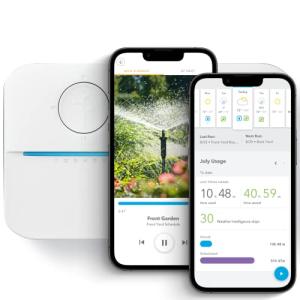
| App Interface | Clean, data-rich mobile application with visual graphs showing soil moisture estimates, historical water usage, and the AI's rationale for its scheduling choices. | Appeals to the data-driven user. Provides transparency into how the "AI" is making decisions, fostering trust in the automation. |
1. The Core of the AI Watering Logic
The primary difference in the AI Smart Sprinkler Controller for DIY Garden Care is the depth of its predictive modeling. It uses a dynamic, learning algorithm that doesn't just check the forecast; it builds a mathematical model of your specific lawn's water needs.
It takes the initial data you provide (soil, sun, slope) and then compares its watering decisions to actual weather outcomes and user feedback. This continuous refinement means that the schedule it runs in the second season is more efficient and accurate than the one it ran in the first.
2. DIY Installation with Pro-Grade Features
Despite the advanced "AI" software, the hardware is designed for straightforward DIY installation. The clear wiring terminals and standard 24V AC compatibility make it easy to swap out an old controller in a garage or utility room.
The controller often includes features usually found on professional models, such as master valve control and rain sensor ports, providing the DIY user with maximum flexibility for an advanced setup. It's a system that empowers the homeowner to achieve professional irrigation results.
3. Data Transparency and Remote Diagnostics
The sophistication of the "AI" is matched by the data transparency provided in the app. You can often view graphs that estimate your soil moisture levels over time and see the exact weather factors that caused the system to delay or increase watering.
This level of detailed reporting is valuable for troubleshooting and understanding water usage, especially in regions with strict watering days. The app allows for quick remote diagnostics, ensuring you can confirm the system is running optimally from any location.
User Profiles
1. The Advanced DIY Landscaper
You view your yard as a complex ecosystem and are constantly optimizing its health. You are comfortable with technical setup and want a system that reflects your meticulous approach to lawn care.
-
Use Case: You need a controller that can manage highly distinct zones (e.g., steep hill, shady rock garden, sunny Bermuda grass lawn) and learn their unique watering characteristics to maximize water efficiency and plant vigor.
-
The Fit: The AI Smart Sprinkler Controller is your ideal match. The extensive setup parameters allow you to fine-tune the "AI" for each micro-environment, and the detailed app feedback gives you the data to confirm the system is working exactly as you intend.
2. The Water-Cost Optimizer
You live in a region with high water rates or tiered pricing, making every gallon wasted an immediate financial concern. You need a system that can demonstrably reduce your water consumption.
-
Use Case: You require the most sophisticated watering logic available to eliminate all unnecessary watering, ensuring your system runs for the minimum time required to maintain plant health, saving you money on your monthly utility bill.
-
The Fit: The predictive nature of the "AI" and its ability to learn and adapt to seasonal changes provides the highest potential for water savings. The detailed consumption reporting in the app makes it easy for you to track and justify your investment.
3. The Tech-Forward Smart Home User
You actively integrate high-tech solutions into all aspects of your life. Your home runs on various smart platforms, and you expect your irrigation system to be one of the most intelligent devices you own.
-
Use Case: You want to link your smart controller to other services, perhaps via IFTTT or a central hub, to create complex automations, like running a zone test immediately after you receive a lawn service completion notice.
-
The Fit: An AI-focused controller usually features a robust API and connectivity options to support deep integration with other smart home control systems. This allows you to treat your irrigation as a sophisticated, integrated component of your overall home technology infrastructure.
"Complementary HomeTechCorner Category Recommendations"
| Recommended Products | Why This Category Is Useful Specifically for This Product | Short Usage Scenario |
| Smart Soil Moisture Sensors | Provides the AI model with ground-truth data, allowing it to rapidly refine its calculations and accelerate its learning phase. | You install a sensor in a tricky, sloped area; the AI uses this real-world data to immediately adjust the run time and frequency, achieving optimal hydration on the hill. |
| Multi Protocol Hubs Matter Thread | A central hub can allow the AI controller to share its data with other smart devices, enabling smarter cross-system automations. | You program a routine in your hub: if the AI controller is running a deep-soak cycle, your exterior lights dim slightly to avoid glare on the wet lawn. |
| Water Shut Off Valves | Given the advanced flow monitoring capability, a smart shut-off valve can be automatically triggered if the AI system detects a catastrophic flow issue. | The AI controller detects an abnormal flow rate at 2 AM; a linked water shut-off valve immediately closes the main line, preventing a major flood and massive water bill. |
| Energy Monitoring Smart Plugs | Allows the power consumption of the controller to be monitored, providing an alert if the unit fails or is drawing inconsistent power. | You receive a notification from the energy monitoring plug that the AI controller hasn't drawn power in two days, signaling a potential transformer issue that needs attention. |
| Outdoor Lighting | You can use the AI controller's schedule data to trigger your outdoor smart lighting, highlighting the areas being watered. | As the AI controller begins the evening watering cycle for the flower beds, a routine automatically turns on the smart spotlights pointed at those beds to showcase your lush garden. |