Food dehydrators are essential tools for anyone looking to extend the shelf life of their favorite snacks while preserving vital nutrients. From crafting homemade jerky to drying seasonal fruits and delicate herbs, these machines offer a level of control over food preservation that store-bought options simply cannot match. Selecting the right model involves balancing capacity, airflow design, and material durability to suit specific culinary needs.
Food Dehydrators
Unlock the potential of your favorite fruits and vegetables with easy dehydration
Product List
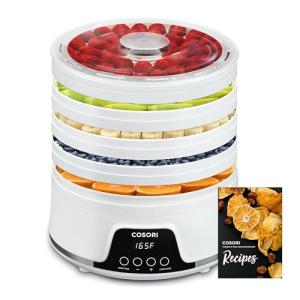
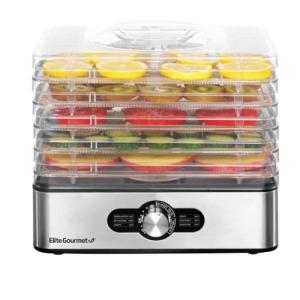
Stainless Steel Food Dehydrator
Elite Gourmet
Product Review Score
4.79 out of 5 stars
217 reviews$39.55 $37.25
💡 Practical Usage Tips
- Always provide at least six inches of rear clearance for units with a REAR-MOUNTED FAN to ensure the motor stays cool and the airflow remains consistent throughout the cycle.
- When using a vertical-flow model, it is helpful to rotate the trays every few hours so that the food closest to the heating element does not dry out faster than the rest.
- For high-moisture items or marinated meats, using solid liners or parchment paper prevents liquid from dripping into the MOTOR HOUSING, which helps maintain the machine's longevity.
- Placing the dehydrator on a hard, flat surface like a countertop prevents the intake vents from being blocked, reducing the risk of the unit overheating or triggering a safety shutoff.
✅ What to Look For & ⚠️ What to Avoid
MUST-HAVES:
- A HORIZONTAL AIRFLOW system, like the one found in the COSORI Food Dehydrator with Stainless Steel Trays, ensures even drying without the need to manually move trays.
- Look for food-grade stainless steel trays because they are more durable than plastic and won't become brittle or retain odors over time.
- Digital timers with auto-shutoff features are essential for safety, allowing the machine to stop automatically once the drying cycle is complete.
RED FLAGS:
- Be cautious of units that rely solely on a MECHANICAL DIAL without a timer, as these require constant manual monitoring to prevent over-drying or safety risks.
- Avoid models with bottom-mounted fans if you plan to dry messy items, as drippings can easily clog the heating element and cause permanent damage.
- Low-wattage units under 300W might struggle with heavy loads of meat, potentially leading to unsafe food temperatures during the drying process.
🛡️ Build Quality & Performance
The overall durability of a dehydrator is often determined by its CHASSIS MATERIAL and heating architecture. High-capacity models, such as the 12-Tray Food Dehydrator, typically feature full stainless steel construction that stands up well to heavy, industrial-style use. These units feel substantial and are less likely to vibrate or produce excessive noise during long operation cycles. In contrast, compact plastic models are lightweight and convenient for small kitchens, though the polymer trays can sometimes show signs of wear or cracking if they are frequently washed in high-heat dishwashers.
Performance is also heavily influenced by the THERMAL STABILITY of the internal sensors. Modern digital models use advanced controllers to keep temperatures within a very narrow range, which is vital for delicate tasks like drying herbs or making yogurt. While older mechanical designs are appreciated for their simplicity and "always-on" capability, they often lack the precision needed for consistent batch-to-batch results. Choosing a unit with a balanced motor and fan assembly ensures that the machine can run for 48 hours straight without significant component fatigue.
🏆 Top Recommendations
| Best For | Model Name | Key Feature | Why It Wins |
|---|---|---|---|
| Professional Use | Psiidan 12-Tray | 1000W Power | Handles bulk loads with industrial efficiency. |
| Precision Drying | COSORI CP267-FD | 360° Circulation | Offers perfectly even heat with no tray rotation. |
| Small Batches | OSTBA 5-Tray | Compact Footprint | Quiet operation ideal for smaller kitchens. |
| Budget Friendly | Elite Gourmet 5-Tray | Mechanical Dial | Simple, reliable, and very easy to operate. |
❓ Frequently Asked Questions
What is the benefit of stainless steel trays over plastic?
Stainless steel trays are more durable and do not warp or become brittle after repeated exposure to high heat. They are also much easier to sanitize and do not absorb odors or flavors from previous batches of food.
Why do some models require tray rotation?
Models with a VERTICAL AIRFLOW design blow air from the bottom up, which means the trays closest to the fan dry much faster. Moving the trays manually during the process helps achieve a uniform result across the entire stack.
Can I run a dehydrator overnight safely?
Yes, most modern units are designed for extended operation. However, it is highly recommended to use a model with an AUTO-SHUTOFF TIMER to ensure the machine turns itself off once the programmed time is reached, providing peace of mind during nighttime use.