
PRODUCT REVIEW
In-Depth U.S. Market Review
The Small Food Dehydrator with 5 BPA-Free Racks occupies a popular and competitive niche in the U.S. kitchen appliance market: the entry-level, budget-conscious dehydrator space. This category targets those new to preserving or with limited kitchen counter space who are looking for a simple, reliable way to make beef jerky, dried fruits, and pet treats.
It excels as a low-commitment appliance, offering a basic feature set that’s perfect for occasional use without the bulk or complex settings of professional models. Its small footprint makes it an ideal choice for apartment dwellers or those who want to easily store it away when not in use.
Compared to large, professional-style horizontal flow dehydrators, you sacrifice high-volume capacity and the promise of perfectly uniform drying on every rack. However, you gain significant savings in initial cost and precious counter space. For consumers who only plan to make a few batches of dried goods a month, this simple, stackable model is a much more practical and budget-friendly choice than a premium stainless steel model.
Technical Analysis
| Specification | Detail & U.S. Context | Analysis |
| Drying Method | Vertical Airflow (Stackable Trays) | Air is heated at the bottom and rises through the trays. This is common for compact, entry-level models, but requires periodic tray rotation for even drying. |
| Tray Material | 5 BPA-Free Plastic Racks | Essential for U.S. consumers concerned about food safety and chemical leaching. The plastic is lightweight, making the unit easy to handle. |
| Temperature Range | Fixed or Limited Adjustment (Typically 95°F – 160°F) | Adequate for most jerky, fruit, and vegetable needs. More advanced models offer finer, digital control for specific raw food preparation. |
| Capacity | 5 Stackable Trays, Approx. 0.5 – 1 sq. ft. total | This small capacity is perfect for making sample batches or for single individuals/couples, but limiting for large families or bulk processing. |
| Power Consumption | Low Wattage (Typically 250W) | Budget-friendly for utility bills. Its low draw means it won't trip household breakers, even when used on older kitchen circuits. |
| Cleanup | Dishwasher-Safe Trays | A major convenience factor in the U.S. market, where ease of cleaning is a key purchase driver for small appliances. |
| Control System | Simple On/Off Switch or Dial | Very easy to use; no complex programming. This simplicity aligns with the "best budget dehydrator choice" market segment. |
1. Heating Element and Airflow Dynamics
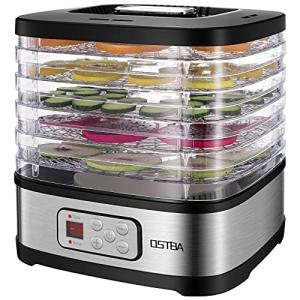
The Small Food Dehydrator relies on a simple vertical airflow system, where the heating element and fan are located in the base. This design is highly compact and economical to manufacture, keeping the consumer price low. The warm air flows up through the center opening of each tray, passing over the food before exiting.
Because of this vertical airflow, you will find that the trays closest to the bottom unit dry significantly faster than those at the top. To ensure all your food dries evenly, you will need to manually rotate the trays—moving the bottom ones to the top and vice versa—midway through the drying process. This is a common trade-off for the compact, entry-level design.
2. Physical Construction and Storage Profile
The construction is primarily lightweight, heat-resistant plastic, prioritizing a small footprint and easy storage. When stacked, the unit takes up a minimal amount of counter space, which is a huge plus for smaller U.S. kitchens. The clear plastic trays allow you to easily monitor the drying progress without having to interrupt the process.
While the plastic construction is durable enough for typical home use, it's not as robust or long-lasting as a stainless steel unit. However, the five BPA-free racks are a major selling point for U.S. consumers concerned about food contact materials. The racks are easy to disassemble and, crucially, are often top-rack dishwasher safe, simplifying the post-dehydrating cleanup.
3. Power and Ease of Use
Operation of this small food dehydrator is extremely simple, often involving just an on/off switch or a basic temperature dial. This lack of complex digital timers or presets makes it highly approachable for first-time users. You don't have to navigate menus or programming; you simply load the trays and turn it on.
The unit typically operates at a low wattage, which is energy efficient and quiet, an important factor if you plan to run it overnight. The simplicity of the controls means you rely on external timers (like your phone or a smart plug) to manage the dehydration duration, which for a "best for beginners" model is often seen as a minor trade-off for the low price.
User Profiles
1. The Entry-Level Preservationist
You are new to food preservation and want to experiment with making your own dried goods without investing in a costly, bulky appliance. You enjoy small-batch experimentation—maybe making a few ounces of custom jerky or a couple of cups of dried apple slices.
-
Use Case: You want to make a small batch of sun-dried tomatoes to store for a winter pasta sauce, or you're drying excess herbs from your small backyard garden.
-
The Fit: This dehydrator's low cost and minimal counter footprint make it the perfect starting point. The simple controls eliminate the learning curve, letting you focus on the food prep rather than complex settings.
2. The Apartment or Dorm Resident
You live in a small space where counter real estate is severely limited, and storage is a constant battle. You only cook for yourself or one other person, and you prioritize appliances that are easy to put away in a cupboard when not in use.
-
Use Case: You are preparing healthy, shelf-stable snacks to bring to work or school, such as dried mango or banana chips, and need an appliance that can be run discreetly overnight.
-
The Fit: The small dimensions and low power draw mean you can easily run this on a kitchen cart or tuck it away in a cabinet. Its quiet operation is essential when living in close quarters.
3. The Custom Pet Treat Maker
You are focused on your pet's diet and want to create all-natural, single-ingredient treats like dried chicken breast strips or sweet potato chews without additives found in store-bought options.
-
Use Case: You are preparing a week’s supply of single-ingredient dog treats using lean meat, needing a machine that can run safely for long periods to fully dehydrate the meat.
-
The Fit: The five BPA-free trays offer enough space for a week's worth of treats, and the low, consistent heat is ideal for safely drying meats. The easy-to-clean trays are a must for handling raw ingredients.
"Complementary HomeTechCorner Category Recommendations"
| Recommended Products | Why This Category Is Useful Specifically for This Product | Short Usage Scenario |
| Energy Monitoring Smart Plugs | These plugs let you set precise drying times and monitor the low wattage this appliance uses, optimizing your energy consumption. | You can start a batch before leaving for work and program the plug to shut the dehydrator off automatically after 12 hours, ensuring you don't over-dry your expensive specialty mushrooms. |
| Smart Power | While this unit is low-wattage, a smart power strip can protect it from power spikes during a long, multi-day drying cycle. | After preparing a large batch of thick-cut jerky, you ensure the dehydrator is protected from an unexpected lightning storm by plugging it into a smart surge protector. |
| Kitchen Scales | Precise food prep is essential for even dehydration, and a good scale ensures uniform thickness across all your food slices. | You consistently slice your apples to a uniform 1/8 -inch thickness by using a reliable kitchen scale as you prep, guaranteeing every piece finishes drying at the exact same time. |
| Smart Home Control | Pairing a simple dehydrator with a central hub allows you to integrate its operation into a wider kitchen automation routine. | When you walk into the kitchen, you can check your hub's dashboard to confirm the dehydrator has been running at the set time for your latest batch of mango slices. |