

PRODUCT REVIEW
In-Depth U.S. Market Review
The Google, T3017US, Nest Learning Thermostat, 3rd Gen , continues to be a dominant and respected player in the U.S. smart thermostat market, even years after its initial release. It is the iconic device that essentially defined the aesthetic and functional standard for the entire category. This model, often available at a slightly more accessible price point than the newest iteration, provides the full "learning" experience—an invaluable feature for consumers seeking maximum energy savings and hands-off convenience.
This 3rd Generation Nest still operates primarily in the premium-to-mid-range segment, targeting homeowners who prioritize proven intelligence and sleek design. Its white color variant is a subtle, modern choice that blends easily with most American wall colors. For homeowners looking for the best smart thermostat for home automation that works with Alexa, the 3rd Gen remains a solid, reliable choice.
Compared to newer models that might focus on Thread/Matter or simpler designs (like the basic Nest Thermostat), the 3rd Gen offers superior screen resolution, the iconic rotating steel ring for manual control, and robust compatibility with older HVAC systems. While it lacks some of the future-proofing of the 4th Gen, its core learning algorithm performance is virtually identical, making it a powerful budget-friendly alternative for the core Nest experience.
Technical Analysis
| Specification | Detail & U.S. Context | Analysis |
| Learning Algorithm | Self-programming capability; creates an optimized schedule based on user adjustments in the first week. | This is the core value proposition; it eliminates manual programming and ensures maximum energy efficiency by learning the household's unique temperature patterns. |
| Display | 2.08-inch 480x480 resolution color display, Farsight feature. | High-resolution for a thermostat, which adds to the premium feel. Farsight allows you to see the temperature/time from across the room, highly appreciated in large U.S. living spaces. |
| Compatibility | Supports 95% of 24V conventional, heat pump, and dual-fuel systems. | Essential broad support for the highly varied HVAC infrastructure across U.S. homes, from central air in the South to heat pumps in the North. |
| Wireless Protocols | Wi-Fi 802.11n, 2.4/5GHz. Proprietary Nest features. | Dual-band Wi-Fi is good for reliability. The focus on Wi-Fi means strong performance but relies solely on the home network and proprietary Nest cloud. |
| Sensor Support | Compatible with Nest Temperature Sensors (sold separately). | This allows for temperature control based on a remote room, solving the common American residential issue of inaccurate readings in hallways or near windows. |
1. Self-Learning Intelligence and Auto-Schedule
The foundational technology is its "Learning" capability, which sets it apart from simple programmable or Wi-Fi thermostats. When you interact with the Nest Learning Thermostat, 3rd Gen , it tracks the time and temperature, compiling these data points into a complex, predictive schedule. This is done entirely automatically.
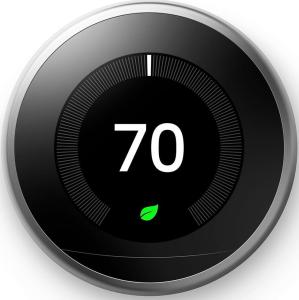
The resulting auto-schedule is dynamic and evolves over time. Crucially for American consumers, the "Nest Leaf" icon appears when you choose an energy-saving temperature, providing instant feedback on green behavior. This gamification is a subtle yet effective tool for encouraging long-term energy-conscious behavior and lowering utility bills.
2. Physical Design and User Interface
The industrial design of the 3rd Gen is highly praised, featuring a high-resolution screen and the smooth, weighted, stainless steel outer ring (in this case, White finish) for tactile control. This physical interface is incredibly intuitive—you simply rotate the ring to change the temperature and press it to confirm or access menus.
In the U.S. market, where many users prefer direct, non-touchscreen control, this dial is a significant advantage over competitors that rely solely on small touch surfaces or app control. The premium materials also make the White finish version look more like a piece of high-end home decor than a functional appliance.
3. C-Wire Requirement and System Compatibility
A common technical point for this older generation is power. The Nest 3rd Gen attempts to draw power ("power-stealing") from the heating/cooling wires, which often works on older systems. However, in many modern, high-efficiency U.S. HVAC systems, or systems with AC, a C-Wire (common wire) is strongly recommended or even required.
Without a C-Wire, users often experience battery depletion, dropped Wi-Fi, or system damage (known as the "thermostat short-cycling"). If you are installing this, especially with an AC unit, you should verify if your current wiring includes a C-Wire or be prepared to purchase and install an adapter kit for reliable operation.
User Profiles
1. The Practical Eco-Conscious Renter
You live in a rental home or condo and want the benefits of a smart thermostat without the commitment or high price of the absolute newest model. You care deeply about saving energy and utilizing Alexa for simple voice control.
-
Use Case: You need an easy-to-install, powerful thermostat that can be removed and taken with you when you move, which will also teach you better energy habits immediately.
-
The Fit: The Nest Learning Thermostat, 3rd Gen, White , is a perfect entry into premium smart climate control. Its proven energy-saving algorithms will quickly reduce your monthly heating/cooling costs. Since it is C-Wire optional (though C-Wire is always better), it’s often compatible with rental property wiring where a C-Wire might be missing, and the installation is manageable as a DIY project.
2. The Multi-Room Climate Balancer
You live in a sprawling ranch or a split-level home, and your thermostat is in a central but often temperature-inaccurate location. Your main concern is ensuring the temperature is perfect in your home office or master bedroom.
-
Use Case: You need a single, central thermostat that can take input from other parts of the house to create a truly balanced climate, minimizing wasted heating or cooling cycles.
-
The Fit: Although sold separately, the 3rd Gen Nest is fully compatible with the Nest Temperature Sensors. You can buy a pack of sensors and strategically place them around your house. This allows the central Nest unit to smartly average or prioritize comfort in specific zones, giving you the best control over those hot or cold spots in your home.
3. The Alexa-First Household
You are completely committed to the Amazon Alexa ecosystem for your smart home, using Echo devices throughout your house for all controls. You want a thermostat that is proven to integrate seamlessly and reliably.
-
Use Case: You primarily use voice commands to control all your smart devices and need a robust, high-performing thermostat that has had years of reliable integration history with Alexa.
-
The Fit: As an established model, the Nest 3rd Gen works flawlessly with Alexa. You can use simple commands like "Alexa, set the main thermostat to 70 degrees" or "Alexa, what's the temperature on the Nest?" The strong Wi-Fi connection ensures the voice commands are executed instantly, without the connection hiccups sometimes found in newer, less-established smart devices.
"Complementary HomeTechCorner Category Recommendations"
| Recommended Products | Why This Category Is Useful Specifically for This Product | Short Usage Scenario |
| Thermostat Accessories | You need trim plates to cover up any existing wall marks or a power adapter if your existing wiring lacks a C-Wire. | You just finished installing your 3rd Gen Nest and use the trim kit to cover the ugly hole left by the old rectangular thermostat, ensuring a clean, professional look. |
| Voice Assistants | Allows for quick, hands-free adjustments using your existing Echo devices connected to Alexa. | When you're bundling up to watch a movie, you can simply tell the Alexa device on your coffee table to raise the temperature two degrees without reaching for your phone or the thermostat. |
| Environmental Sensors Temp Humidity | Augments the Nest's primary sensor by providing more detailed data on air quality or localized temperature variations in specific rooms. | You place a dedicated sensor in the baby's room, and then set up a custom automation within Alexa to notify you if the temperature deviates from a safe range. |
| Smart Displays | Provides a dedicated, visual dashboard to monitor and adjust the temperature across multiple zones/sensors at a glance. | You walk into the kitchen and check your Smart Display to confirm the Nest has shifted its focus to the bedroom sensor for the nighttime schedule, ensuring comfort before you head to bed. |
| Smart Power | Useful for monitoring energy-consuming appliances linked to your heating/cooling like auxiliary fans or whole-house humidifiers. | You plug your whole-house humidifier (if not hardwired) into an energy monitoring smart plug to track its power use and see its total cost compared to your Nest's reported HVAC usage. |
| Networking Gear | Ensures a strong, stable Wi-Fi connection, which the C-Wire-less Nest 3rd Gen models can occasionally struggle with if the signal is weak. | You install a Wi-Fi Mesh point near the thermostat to guarantee it always has a full-strength signal, preventing drops and ensuring your programmed schedules run without interruption. |