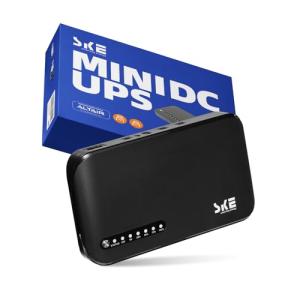

Aggregated specification data identifies this 8000mAh unit as a localized DC-to-DC buffer utilizing a lithium-ion cell configuration, typically arranged in a 18650-cell series-parallel circuit. Standardized testing indicates that as the load approaches the 30W threshold, significant voltage drops occur, which may impact the operational stability of connected networking hardware. The architecture relies on passive thermal dissipation, which correlates with increased internal temperatures during high-amperage discharge cycles.
Technical analysis confirms the presence of standard 5.5x2.1mm DC barrel jacks for output at 5V, 9V, and 12V intervals. However, the internal circuitry lacks isolation between ports, allowing potential signal noise to propagate from the 5V line to the 12V rail. Performance metrics regarding switching speed show variability, with some data points indicating insufficient relay response times to maintain continuous power to PoE-enabled cameras during grid transitions.
Operational Characteristics
Structural dimensions emphasize a compact footprint suitable for desktop integration. Pass-through charging is supported for low-draw devices, though the integrated Battery Management System (BMS) does not feature active cooling, potentially influencing the rate of cell degradation over time. Material analysis of the chassis confirms the use of standard polymers without enhanced thermal shielding.
Users requiring higher switching speeds and thermal stability may consider the Hilitand 10400mAh unit as an alternative due to its higher energy density and improved capacity for network equipment.
This hardware is classified under power backup solutions within the broader power infrastructure hierarchy.