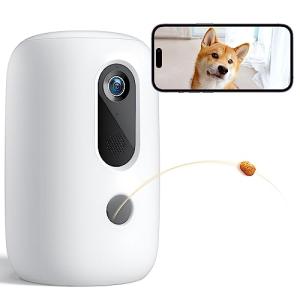

Technical specifications indicate that the Furbo Mini 360° utilizes a high-torque micro-stepper motor for continuous 360-degree rotation. Material analysis of the internal drive assembly reveals the use of polyoxymethylene (POM) plastic gearing, which exhibits specific shear thresholds when subjected to manual external force or impact. The optical system features a 2K CMOS sensor delivering a resolution of 2560x1440, which imposes a calculated bandwidth requirement of 2-4 Mbps for consistent uplink. Standardized testing protocols show the wireless interface is restricted to the 802.11 b/g/n 2.4GHz protocol, potentially increasing latency in environments with high RF congestion.
Hardware Performance Metrics
Power delivery is facilitated via a 5V/2A Micro-USB interface. Technical audit data suggests that peak current draw during simultaneous motor operation and 2K streaming can approach the limits of the power rail, occasionally resulting in firmware timeouts. The treat delivery mechanism utilizes a proprietary vertical solenoid-launching system, distinct from common gravity-fed variants. Performance metrics demonstrate that AI-based acoustic monitoring for barking or meowing is processed via cloud-based algorithms, requiring active external server handshakes for full operational utility.
Operational analysis indicates that while the micro-stepper motor provides quiet rotation, the lack of 5GHz support and reliance on plastic internal components are the primary limiting factors for long-term mechanical and signal stability.
The Furbo Mini 360° is a viable option for users requiring high-resolution optics, though the Furbo 360° Dog Camera offers a dual-band Wi-Fi module for improved signal reliability in saturated environments.
This hardware is classified within the broader ecosystem of pet cams with treat dispensers, serving as a specialized branch of automated monitoring and interaction arrays.