
PRODUCT REVIEW
In-Depth U.S. Market Review
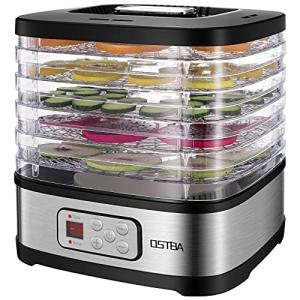
The Food Dehydrator with 5 BPA-Free Trays is a quintessential "best budget dehydrator choice" in the U.S. appliance space. It’s an entry-level, no-frills machine aimed squarely at the first-time user, the college student, or the consumer who only plans to make small, occasional batches of dried snacks. Its value proposition is centered on simplicity, small footprint, and low initial cost, making it highly competitive against other basic stackable models.
This dehydrator's design focuses on core functionality: a heat source, a fan, and stackable trays. It avoids the added cost of digital controls, high wattage, or premium materials. Compared to more expensive models, you’ll trade features like a programmable timer and guaranteed even drying for a highly affordable price and extremely user-friendly operation. For many U.S. households, this simple, compact model is all they need to start making basic jerky or dried fruit slices at home.
Technical Analysis
| Specification | Detail & U.S. Context | Analysis |
| Capacity | 5 Stackable Trays | Standard size for entry-level units, offering enough space for small batches of personal snacks or drying herbs. |
| Material | BPA-Free Plastic Trays & Base | The BPA-free designation is a crucial health and safety requirement for many U.S. consumers, offsetting the preference for stainless steel. |
| Control | Simple On/Off Switch | Extremly basic operation, eliminating any programming complexity. The user relies on external monitoring for time control. |
| Temperature | Fixed or Limited Analog Control | Typically operates at a single, general-purpose heat setting (around 13 5 ∘ F ), which works for most common fruits and veggies but limits versatility. |
| Airflow | Vertical Flow | Heat rises from the base. This method is space-efficient but requires manual rotation of the trays (top to bottom) during the cycle for even drying. |
| Cleaning | Dishwasher-Safe Trays | A significant ease-of-use factor. The trays are usually lightweight and simple to clean after use. |
| Dimensions | Compact Tower Design | The small diameter makes it an excellent fit for crowded U.S. kitchen counters and easy storage in cabinets. |
1. Simplicity of Operation and Controls
The design philosophy of this food dehydrator is rooted in maximum simplicity. The primary mode of operation is typically a single on/off switch, or perhaps a very basic analog dial. This lack of complex digital settings means there is virtually no learning curve, making it perfect for beginners.
You simply prep your food, stack the trays, plug it in, and turn it on. While this simplicity is a huge plus, it means you must manage the drying time yourself using a separate kitchen timer or your phone. This minimal interface keeps manufacturing costs low, resulting in a low retail price for you.
2. Food Safety and Material Composition
A key feature, particularly emphasized for the U.S. market, is the assurance that the five trays are BPA-free. This addresses modern consumer anxieties about chemical leaching from plastics into food. For a budget-conscious appliance, this designation provides essential peace of mind.
The plastic trays are lightweight and easy to handle when loaded, but they require careful cleaning—while often labeled "dishwasher safe," it’s generally recommended to stick to the top rack to avoid warping from high-heat drying cycles.
3. Airflow and Drying Efficiency Trade-offs
The unit utilizes the standard vertical airflow design common to entry-level dehydrators. The heat and fan are concentrated in the base, pushing warm air up through the central column. This means the bottom trays closest to the heat source will dry faster.
For optimal results, you must manually rotate the trays every few hours. This is the main trade-off for the compact size and low cost. If you're only drying small, quick-drying items like herbs, this effect is less noticeable, but for thick-cut fruit or jerky, rotation is essential.
User Profiles
1. The College Student/Renter
You live in a small apartment or dorm and have limited budget and counter space. You're looking for an affordable, non-bulky way to make your own healthier snacks rather than buying expensive store-bought options.
-
Use Case: You want to make a small batch of dried chili flakes from your patio garden or a few containers of dried banana chips for study snacks.
-
The Fit: The ultra-compact footprint and low price are perfect for your limited space and budget. The simplicity of the on/off switch means you can operate it without needing to learn complex cooking techniques.
2. The Kitchen Experimenter
You are interested in the concept of food preservation but aren't sure if you'll stick with the hobby. You want to test the waters with a variety of recipes—from pet treats to dried flower petals—before committing to a higher-end unit.
-
Use Case: You are trying your hand at making chicken jerky for your dog for the first time and need a straightforward machine to get a feel for the process.
-
The Fit: The low initial investment makes this a great way to "try before you buy" a more advanced model. Its ease of cleaning and BPA-free trays provide a worry-free testing environment.
3. The Bulk Herb Drier
You maintain a substantial herb garden and primarily need an efficient, dedicated appliance for drying large quantities of mint, rosemary, or basil for storage. Herb drying requires low heat and good airflow, but not necessarily a complex timer.
-
Use Case: You are harvesting a large amount of basil to make dried herbs for winter cooking and need a machine that can run reliably for a day or two without constant attention.
-
The Fit: The five trays provide ample capacity for layering thin sheets of herbs. Since herbs dry quickly at a low, consistent temperature, the basic controls are perfectly adequate for your specific, high-volume need.
"Complementary HomeTechCorner Category Recommendations"
| Recommended Products | Why This Category Is Useful Specifically for This Product | Short Usage Scenario |
| Energy Monitoring Smart Plugs | Since this unit lacks a built-in timer, a smart plug is essential for automatic shut-off and monitoring the energy usage of long cycles. | You set a 15-hour drying cycle for your apple chips using the smart plug app so the machine shuts off at 3 AM while you're sleeping, ensuring they aren't over-dried. |
| Kitchen Scales | Using a scale to ensure all your food slices are uniform is critical for this vertical-flow unit to achieve the most consistent results possible. | You use your kitchen scale to weigh out the precise amount of food for each of the five trays so they all have a similar mass, reducing the difference in drying time. |
| Smart Home Control | Pairing the simple on/off switch with a central hub gives you basic remote power control and confirmation of the unit's status. | You can quickly ask your voice assistant, integrated through your smart home control, to turn the dehydrator off as you walk out the door for an errand. |
| Contact Sensors | Placing a simple contact sensor near the dehydrator can alert you if the trays or lid are accidentally moved during the drying cycle. | You place a contact sensor near the lid, ensuring you'll get an alert on your phone if your curious pet bumps the appliance and disrupts the airflow. |