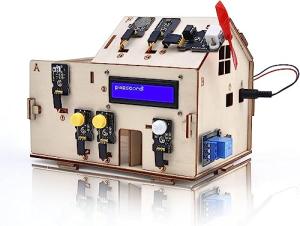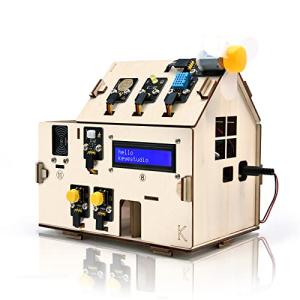

Technical specifications indicate that the core of this prototyping ecosystem is an ATmega2560 microcontroller. Performance metrics demonstrate a significant input/output capacity, featuring 54 digital I/O pins and 16 analog inputs, which supports the integration of extensive sensor arrays without the requirement for multiplexing hardware. Standardized testing protocols confirm the utilization of a 16MHz crystal oscillator, ensuring stable clock cycles for timing-sensitive operations such as pulse-width modulation (PWM) and ultrasonic signal processing.
Hardware Architecture & Material Analysis
Material analysis of the circuit board assembly confirms the use of high-quality solder masking and high-contrast silk-screen labeling to mitigate assembly errors. The physical footprint of the Mega R3 board is larger than standard Uno-class controllers, which influences enclosure specifications for custom builds. Power management analysis suggests that while the board accepts USB bus power, high-draw mechanical components require the 9V 1A power adapter included in the kit to prevent voltage sag and unexpected logic resets.
Shutterstock
Aggregated specification data confirms the inclusion of over 200 discrete components, including an LCD1602 display module, RFID peripherals, and specialized water-level sensors.
Functional operation is supported through several modes:
- Standard Serial Communication
- PWM Output Control
- I2C/SPI Data Protocols
- Analog-to-Digital Conversion
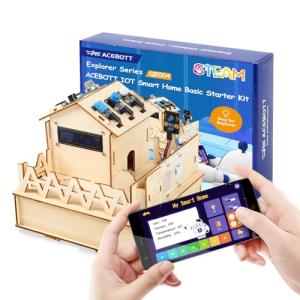
While the hardware offers substantial processing overhead, technical documentation notes the absence of native wireless protocols. Implementation of networked automation requires the addition of external communication shields. To address higher processing requirements or native networking, the Keyestudio ESP32 Smart Home Starter Kit offers a dual-core chipset with integrated Wi-Fi and Bluetooth capabilities.
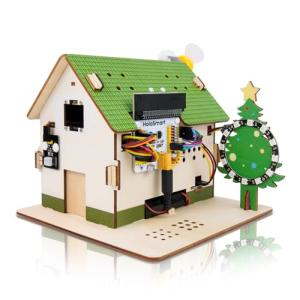
This hardware bundle functions as a foundational component within the broader entry-level automation kits classification, serving as a primary tool for logic development and hardware prototyping.