
Technical specifications for the BroadLink RM4 Pro indicate a specialized hardware configuration designed for bridging legacy infrared (IR) and radio frequency (RF) hardware into modern network environments. Unlike standard IR blasters, material analysis of the internal PCB reveals a dual-frequency RF transmitter supporting both 433MHz and 315MHz bands, which facilitates communication with older motorized shades and ceiling fans.
Performance metrics are driven by a MediaTek MT7688KN chipset, a common architecture for Linux-based IoT gateways. Standardized testing protocols highlight the utility of the modular HTS2 sensor port, which externalizes temperature and humidity tracking to mitigate interference from the unit's internal heat dissipation. This modular approach ensures that environmental data remains unimpacted by the device's operational thermals.
System diagnostics confirm that the RM4 Pro operates exclusively on 2.4GHz Wi-Fi frequencies, necessitating the use of split SSIDs in dual-band network environments.
Operational data lists the following functional capabilities:
- Dual-frequency RF transmission (433MHz and 315MHz).
- Support for 50,000+ pre-coded infrared libraries.
- Local polling compatibility for integrated automation platforms.
- Modular environmental sensing via external cable.
Aggregated specification data confirms a custom PCB layout that distinguishes this unit from standard white-label Tuya emitters. While the chassis is composed of lightweight polymers, the internal IR emitter array is configured for high-density coverage across the localized environment.
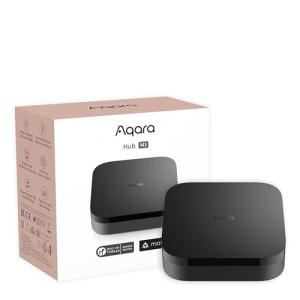
The Aqara Smart Home Hub M3 is recommended as an alternative for installations requiring Power over Ethernet (PoE) and a native Matter controller to eliminate the 2.4GHz Wi-Fi constraints found in this model.
This unit serves as a specialized gateway within the broader IR/RF hub classification for legacy device integration.