
PRODUCT REVIEW
In-Depth U.S. Market Review
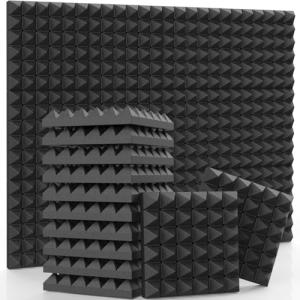
The Audiosoul 52 Pack High-Density Acoustic Foam Panels are positioned as a performance-forward solution for the serious U.S. home studio builder or amateur musician. Where many budget foams cut corners on density, this product specifically targets users who understand that density is directly proportional to lower-frequency absorption capability. It competes strongly in the mid-range of the foam market by offering a high volume of panels with enhanced structural integrity for better sound capture.
This package offers a powerful combination of volume and quality, providing the best sound absorption for budget home studios . When compared to thin, 1-inch foam panels, you get significantly deeper treatment penetration into the sound wave, resulting in a tighter, more professional sound for instruments like bass guitars or kick drums. You are essentially buying a large, high-value kit optimized for a professional-grade acoustic outcome in a residential setting.
Technical Analysis
| Specification | Detail & U.S. Context | Analysis |
| Quantity & Size | 52 panels, each 12" x 12" x 2" (30.5 x 30.5 x 5 cm) | Provides a massive amount of coverage (52 sq ft) for treating entire rooms or constructing vocal/instrument isolation booths. |
| Material | High-density, open-cell polyurethane foam | The high density means more material per cubic foot, leading to greater mass and better energy conversion (sound to heat) at lower frequencies. |
| Density (Performance) | Above 1.8 PCF (Pounds per Cubic Foot) density is typical for "high-density" claims in this class | This enhanced density helps move the effective absorption curve down towards the low-mids (200-500 Hz), which is vital for quality recordings. |
| Recovery Rate | Designed for quick and complete recovery from vacuum compression | Crucial for performance; a panel that doesn't fully recover its thickness loses its advertised low-frequency absorption benefit. |
| Design Profile | Wedge or Pyramid profile (depending on batch, typically wedge) | The wedge shape offers a sharp, defined edge that helps in scattering high frequencies while maximizing foam-to-air surface interaction. |
| Fire Resistance | Self-extinguishing materials (always check local fire codes) | While not true fireproofing, this rating is essential for peace of mind when installing large quantities of foam in a residential U.S. structure. |
| Installation | Requires separate aerosol adhesive or mounting putty/strips | The sheer volume of panels makes the choice of adhesive critical; you should budget for multiple cans of professional acoustic spray glue. |
1. High-Density Foam Structure and Absorption Efficiency
The primary advantage of the Audiosoul panels is their high-density foam structure . For anyone recording instruments or mixing music, density is key because lower frequencies (bass, rumble) have longer wavelengths that require more mass and depth to effectively absorb. You will find that these 2-inch, high-density panels significantly outperform thin 1-inch foam by providing a noticeable clarity boost in the mid-range of your recordings.
This high-density composition helps reduce the overall decay time of sound (Reverb Time) in your room faster than typical budget foam. By quickly dissipating sound energy, you are left with cleaner direct sound, which allows your monitor speakers and microphone to perform at their absolute best.
2. Compression/Recovery and Long-Term Durability
Since these large packs are shipped vacuum-compressed, the foam's ability to return to its full, un-deformed 2-inch thickness is a crucial indicator of quality. A good high-density foam, like what you find here, should recover quickly—often within 24 to 48 hours after being removed from the vacuum seal. If you want a faster result, a quick tumble in a dryer on low heat or a light spritz of water can speed up the process.
Durability is another factor: higher density means the foam is less likely to tear during installation and less prone to crumbling or breaking down over years of use, especially when exposed to light temperature fluctuations in a U.S. garage or basement studio. You are investing in a product that maintains its acoustic properties for the long haul.
3. Installation Tactics and Recommended Placement
With such a large quantity of 52 panels, you have the opportunity to employ advanced acoustic treatment tactics. Instead of just spot-treating, you can create dense cloud treatments above your mixing position or build floor-to-ceiling corner bass traps by folding the panels, assuming you use separate bass-trap material in the corners.
The key is strategic placement: focus on the mirror points (first reflections) on all surfaces first, then fill in sections of the wall behind your monitor speakers and listening position. Because you have so many, you can even experiment with double-layering in particularly problematic areas to maximize absorption, though this is often unnecessary given the 2-inch thickness.
User Profiles
1. The Home Studio Mixer/Engineer
You are dedicated to achieving professional-grade mixes in your home, which means you need to control reflections and standing waves across the mid-range frequencies. Clarity and accurate translation of your music are paramount.
-
Use Case: Treating your 12x15 foot mixing room to achieve an acceptable Reverb Time (RT60) across the critical 200 Hz to 4 kHz range.
-
The Fit: The high-density, 2-inch thickness is exactly what is required to manage the longer wavelengths produced by monitor speakers. The 52-pack ensures you have enough material to treat not only the walls but also the ceiling and rear areas effectively.
2. The YouTube Voice-Over Artist
You record voiceovers, narrations, and audiobook content where the slightest room sound is immediately distracting to the listener. Your income depends on pristine audio quality.
-
Use Case: Building a small, dedicated vocal booth using PVC pipe or a corner closet, requiring near-complete coverage inside a small enclosure.
-
The Fit: The high volume and density allow you to fully line the walls of a small booth, creating a near-dead acoustic environment. Your voice will be dry, focused, and free of any residual echo, which is the hallmark of professional spoken-word content.
3. The Basement Band Practice Space
Your band practices in your basement, and the sound is overwhelming, loud, and muddy, causing your neighbors to complain. You need to dampen the sheer volume of sound traveling through the walls and reduce the internal chaos.
-
Use Case: Installing a high volume of panels on the shared walls and ceiling to both improve the internal sound quality and slightly reduce sound transmission outside the room.
-
The Fit: While acoustic foam is primarily for absorption rather than isolation , the sheer volume of 52 panels, when covering large sections of a wall, can slightly reduce volume leakage while making the practice environment much more pleasant and acoustically workable for the musicians.
"Complementary HomeTechCorner Category Recommendations"
| Recommended Products | Why This Category Is Useful Specifically for This Product | Short Usage Scenario |
| Smart Lighting For Battlestations | The deep, black foam is visually dense and can make a room feel darker, requiring purposeful lighting to highlight the space. | You turn on your smart strip lights which are mounted behind the panels, creating a dramatic halo effect around the treated walls. |
| Studio Usb Microphones | The high-density foam ensures that your high-quality microphone can capture every detail without the pollution of room echo. | You lean into your mic to record a delicate vocal harmony, confident that the Audiosoul panels are isolating your performance perfectly. |
| Home Theater Speaker Kits | Professional-grade acoustic treatment is essential for getting the most accurate sound stage and imaging from a high-fidelity speaker setup. | You queue up a reference track and notice the clarity of separation between instruments is now pinpoint accurate, thanks to the controlled reflections. |
| Usb C Hubs | A professional setup requires multiple wired peripherals (monitors, audio interfaces), and acoustic treatment complements a clean, functional workspace. | You plug your audio interface into the smart hub, knowing the entire desktop ecosystem is geared towards efficiency and sonic purity. |
| Dedicated Home Automation Controllers | You need to integrate your studio equipment (lighting, ventilation) into one system to prevent unwanted noise during recording sessions. | You execute a single command on your controller, instantly shutting down the smart fan and dimming the lights before hitting the record button. |