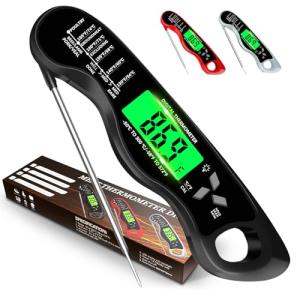

PRODUCT REVIEW: Rubbermaid Instant Read Meat Thermometer - Pocket Size
In-Depth U.S. Market Review
The Rubbermaid Instant Read Meat Thermometer is an industry-standard, classic, analog tool that continues to hold a significant place in the U.S. kitchen. It is positioned as the ultra-budget, essential analog thermometer for basic food safety and serves as a reliable, non-electronic backup or primary tool for the most basic home cooks and food service professionals. It targets users who prioritize durability, zero maintenance, and the absolute lowest price point.
Its niche is the non-electronic, highly rugged utility sector. This thermometer does not require batteries, cannot fail due to water damage, and is built to be a simple, reliable safety check device. It is a staple in many American commercial kitchens due to its low cost and durability.
Compared to any digital thermometer, it is significantly slower (often 10–20 seconds) and less accurate. However, its value lies in its simplicity and reliability—it will always work. It’s an ideal product for someone who just needs a quick, general check for doneness and food safety, making it a timeless, dependable budget option.
Technical Analysis
| Specification | Detail & U.S. Context | Analysis |
| Technology | Analog/Bi-Metallic Coil | Requires no batteries and is virtually indestructible in a standard kitchen environment, making it a reliable backup or travel tool. |
| Response Time | Slow (Typically 10–20 Seconds) | Requires the user to wait for the dial to stabilize, which is less ideal for grilling but perfectly acceptable for checking roasts or liquids. |
| Accuracy | Functional ( ± 2 ∘ F to ± 5 ∘ F ) | Sufficient for basic food safety checks (e.g., Is the chicken over 16 5 ∘ F ?), but not precise enough for professional culinary use. |
| Design | Pocket/Pen Style with Sheath | Extremely portable and includes a protective sheath with a clip, making it easily accessible and safely storable in a drawer or shirt pocket. |
| Dial Readout | Clear Markings for Doneness | Features color-coded or labeled zones (e.g., 'Poultry,' 'Beef') for quick visual checks, which is helpful for novice cooks. |
| Calibration | Simple External Calibration Nut | Can be re-calibrated using a wrench or pliers (not included) and an ice-water bath, ensuring long-term reliability without electronic components. |
| Material | Stainless Steel/Durable Plastic | Built to withstand commercial kitchen use, including occasional drops and exposure to high heat and moisture. |
1. Durability and No-Maintenance Simplicity
The primary feature of the Rubbermaid Instant Read Meat Thermometer is its analog, bi-metallic coil technology. This means there are no batteries to replace, no electronics to fail, and no displays to scratch. For you, this translates to a tool that will last for years with virtually zero maintenance.
This inherent ruggedness makes it the go-to essential analog thermometer for basic food safety for camping, large gatherings, or as a reliable backup when digital devices might fail. Its commercial-grade design ensures it can handle the inevitable drops and frequent washing of a busy kitchen.
Its mechanical simplicity is its strength, offering dependable performance without relying on any external power source or complex software.
2. Clear Dial and Basic Food Safety Focus
The dial is designed for rapid interpretation, often featuring clear markings for common cooking temperatures and pre-labeled food zones (e.g., for pork, beef, poultry). This visual guidance is perfect for the cook who only needs a quick confirmation of doneness.
While the accuracy is not as precise as a digital model, the functional range ( ± 2 ∘ F or more) is sufficient for confirming basic food safety—the difference between 16 0 ∘ F and 16 5 ∘ F is close enough for a general safety check.
For the value-focused consumer, this provides the critical safety information needed for everyday cooking in the most straightforward way possible.
3. Pocket Size and Sheath Convenience
The pocket-size, pen-style design is incredibly convenient for storage and portability. It comes with a sheath that protects the sharp probe tip, often featuring a clip so it can be safely stored in a chef’s pocket or clipped onto a drawer organizer.
This portability is highly valued in the U.S. food service industry and by home cooks who take their cooking tools on the go for BBQs, camping, or potlucks. You can throw it into a kitchen kit without worrying about battery draining or damage.
The external calibration nut is a sophisticated feature for a basic analog tool. It allows you to manually adjust the needle using a known temperature (like ice water), ensuring that you can restore its original accuracy over time, adding to its long life.
User Profiles
1. The Value-Oriented, Simple Cook
You are only concerned with ensuring your chicken and pork are safe to eat, and you don't care about achieving precise medium-rare temperatures. You want the least expensive, most durable tool that requires no batteries or setup.
-
Use Case: You are checking the internal temperature of a baked whole chicken to make sure it's safely over 16 5 ∘ F before taking it out of the oven.
-
The Fit: The Rubbermaid Analog Thermometer is the absolute essential analog thermometer for basic food safety you need. Its low cost, durability, and complete lack of electronics mean it is completely reliable and requires zero ongoing maintenance.
2. The Outdoor/Camping Chef
You frequently cook outdoors, tailgate, or camp, where you need a thermometer that is completely weatherproof, durable, and doesn't rely on battery power. You need a reliable backup for your primary digital units.
-
Use Case: Checking a burger on a campfire grill or a foil-wrapped potato in the embers, where a digital thermometer might fail due to heat or moisture.
-
The Fit: Because it has no electronic components, it’s completely immune to water damage and extreme temperatures, making it the perfect rugged companion for any outdoor cooking adventure. It will always work when you need it most.
3. The Commercial Kitchen or Shared Space User
You are buying thermometers for a school kitchen, a food truck, or a shared apartment kitchen. Durability, simplicity, and ease of mass cleaning are more important than ultra-precision.
-
Use Case: Buying a dozen of these for quick, constant checks in a high-volume, high-turnover environment where tools are often dropped or washed aggressively.
-
The Fit: The high durability, low cost, and ability to be cleaned vigorously without worry about electronics make it the ideal, economical choice for a professional or shared basic food safety environment.
"Complementary HomeTechCorner Category Recommendations"
| Recommended Products | Why This Category Is Useful Specifically for This Product | Short Usage Scenario |
| Smart Displays | Even with an analog tool, a smart display is crucial for managing the timing you need to allow the slow analog reading to stabilize. | You insert the probe and then ask your kitchen smart display to set a 30-second timer to ensure you give the slow analog needle enough time to settle on the final temperature. |
| Smart Meat Thermometers | You can use the analog thermometer to double-check the calibration of your expensive smart wireless probe before a long cook. | Before you put your roast in the smoker, you use your basic analog thermometer and an ice bath to confirm that your new smart probe is reading the temperature correctly. |
| Kitchen Scales | For food service or batch cooking, using a scale to measure portions is vital and complements the thermometer's safety check. | You weigh out individual portions of ground beef on a kitchen scale, cook them, and then use the basic thermometer to confirm the minimum internal temperature of each patty. |
| Multi Cookers Pressure Cookers | A basic thermometer is useful for checking the temperature of liquids or items immediately after depressurization when the digital probe is being used elsewhere. | After opening the pressure cooker, you quickly insert the analog probe to confirm the broth is ready for serving without waiting for another thermometer to cool down. |