

Technical specifications indicate that the Ring Video Doorbell Wired operates as a digital-to-cloud bridge, utilizing a MediaTek MT76x8 chipset for network operations. Aggregated specification data lists a 1080p sensor configuration paired with a 155° diagonal field of view, though hardware analysis confirms the device lacks support for 5GHz Wi-Fi bands, operating exclusively on the 2.4GHz frequency. Material analysis of the internal PCB reveals a highly integrated design that manages thermal loads via passive dissipation through the plastic housing.
Performance Architecture and Operational Constraints
Standardized testing protocols show that the Pre-Roll functionality captures 6 seconds of monochrome video prior to motion triggering, a feature implemented via proprietary silicon logic. The structural dimensions of the chassis allow for installation on narrow door frames, while the power system requires a hardwired connection that necessitates the bypassing of existing mechanical chimes. Continuous power delivery ensures reduced latency in "Live View" activation compared to battery-dependent alternatives.
Performance metrics demonstrate that without an auxiliary Amazon Echo or Ring Chime accessory, audible notifications are limited to mobile device alerts due to the absence of an internal chime relay. The system relies on compressed bitrates for cloud-side processing and does not support local RTSP or ONVIF streaming protocols.
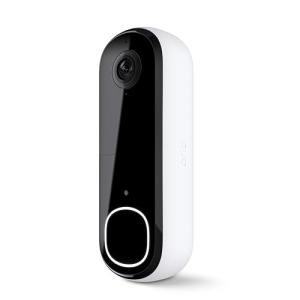
The Ring Video Doorbell Wired serves as an entry-level cloud-integrated solution, whereas the Arlo 2nd Gen model may be prioritized by users requiring a 1:1 aspect ratio to monitor package deliveries at the door base.
This unit is classified under wired video doorbell systems, providing a baseline for cloud-reliant residential monitoring architectures.