
Mechanical analysis of the EWA A106 Pro reveals a high-density metallic alloy chassis designed to serve as a high-mass acoustic chamber. This construction facilitates the operation of a 3W neodymium driver and a downward-firing passive radiator, with the metal housing effectively minimizing harmonic distortion. Performance metrics indicate that the unit achieves a specific frequency response by utilizing surface coupling, where the mounting substrate acts as a secondary resonator.
Standardized testing of the Bluetooth 5.0 implementation demonstrates stable protocol handshaking, suitable for integration with local automation bridges. The power subsystem includes a 700mAh lithium-ion battery hard-soldered to the primary PCB. Ingress protection is rated at IP67, utilizing a single-button interface to reduce potential points of liquid penetration into the internal circuitry.
Technical documentation notes that low-frequency performance is highly dependent on placement; soft or porous surfaces will attenuate the output of the downward-firing radiator. Hardware revisions may include either Micro-USB or USB-C interfaces, affecting the mechanical durability of the charging port over extended duty cycles.
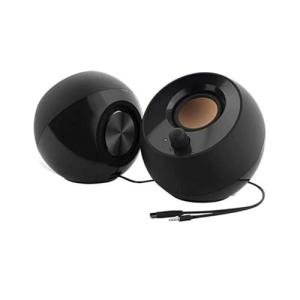
Users seeking a larger soundstage for desktop environments may consider the Creative Pebble 2.0 as an alternative that prioritizes driver separation over the A106's ultra-compact mobility. Evaluation of these hardware tiers is provided within the centralized budget speaker specification database.