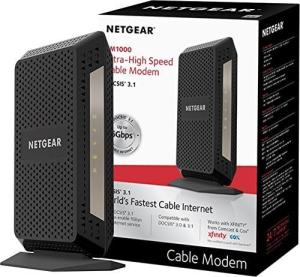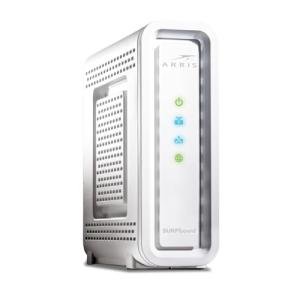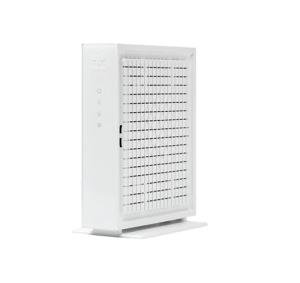

Technical specifications indicate the SB8200 utilizes the Broadcom BCM3390 chipset, a hardware standard that provides operational stability during high-throughput demands. Material analysis of the chassis reveals a vertical orientation designed to facilitate passive thermal dissipation, maintaining internal component temperatures within standard operating parameters. Aggregated specification data confirms the inclusion of two 1-Gigabit Ethernet ports; however, utilization of the secondary port is contingent upon Internet Service Provider (ISP) configuration for Link Aggregation or the provisioning of a secondary IP address.
Hardware Architecture & Integration
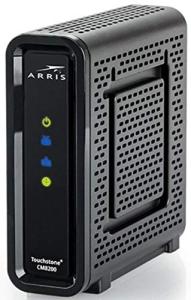
Internal component analysis identifies the Arris CM8200 as an equivalent hardware match, typically deployed in enterprise service-provider environments. System protocols dictate that firmware management is handled exclusively by the cable provider, as manual override capabilities are not present in the device's architecture. To prevent thermal throttling, structural placement requires an unobstructed environment to ensure the efficacy of the passive cooling design.
- Operating Modes: Bridge Mode only; requires external routing hardware.
- DOCSIS Standard: 3.1 supporting 2x2 OFDM channels.
- Status Indicators: Multi-LED front panel for downstream, upstream, and power monitoring.
Performance metrics demonstrate a resistance to the latency jitter frequently documented in alternative silicon architectures, supporting sustained data packet delivery across a 32x8 channel bonding configuration.
Those seeking a more compact footprint with updated port configurations might consider the Arris Surfboard S33, which replaces dual 1GbE ports with a singular 2.5 Gbps interface. This bridge unit functions as a primary node within the broader DOCSIS 3.1 modems hardware classification.