
Material science analysis of this Anker PDU identifies a 45-degree flat plug design with a 0.5-inch profile, engineered to reduce cable strain in tight clearances. The internal architecture utilizes a Metal Oxide Varistor (MOV) array for surge suppression. Technical documentation confirms the USB module employs a dedicated buck converter capable of a 30W total shared output, utilizing PowerIQ technology to optimize charging protocols for connected hardware. The chassis is constructed from V-0 flame-retardant polycarbonate.
This is a purely analog/mechanical device, containing no Wi-Fi or Zigbee radios, which results in a zero-latency hardware response and no firmware-related vulnerabilities. The aggregate load is managed via a manual rocker switch, and the unit lacks the ability to provide software-based toggling or energy telemetry. Standardized data indicates that while the USB-C ports support higher wattages, the power delivery will throttle when the USB-A ports are simultaneously occupied.
Technical audits confirm a 7-point safety system including over-voltage and short-circuit protection, though the surge capacity is rated for basic home office use rather than industrial environments.
Summary: A high-durability mechanical power strip prioritized for spatial efficiency and USB stability, designed for users who do not require remote automation.
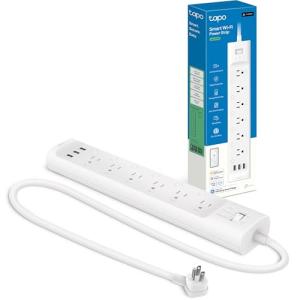
To add remote scheduling capabilities to this robust mechanical platform, the Tapo Smart Wi-Fi Power Strip with 6 Outlets can be used as a primary automation node. Tapo Smart Wi-Fi Power Strip with 6 Outlets
This device represents a high-quality hardware standard within the category of desktop power distribution. smart power