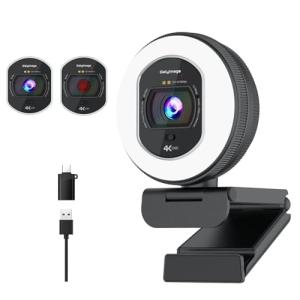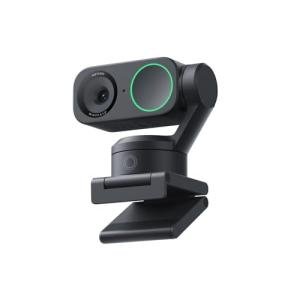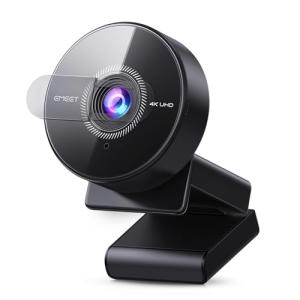

Material analysis confirms a polymer-based housing equipped with a high-tension hinge designed for contemporary display bezels. The optical stack features a Phase Detection Auto Focus (PDAF) system, which utilizes light-phase differential calculation to achieve focus lock without the oscillation common in contrast-based modules. Digital Signal Processing (DSP) is applied to the dual-microphone beamforming array to isolate vocal frequencies and mitigate ambient acoustic interference.
The device operates via the Universal Video Class (UVC) protocol, ensuring driverless compatibility across multiple operating systems. Performance metrics indicate that extended 4K streaming sessions result in elevated thermal output on the external chassis surface. Monitoring of power draw suggests that direct connection to a motherboard-integrated USB-A port or a powered hub is necessary to maintain signal stability at high bitrates.
Technical data lists a 73-degree diagonal field of view, optimized for single-subject framing in professional conferencing scenarios.
While auto-light correction algorithms are present, the small sensor geometry exhibits increased signal noise in environments with low lux levels. The inclusion of a physical sliding mechanism provides a hardware-level privacy barrier.
For users requiring a larger 1/2-inch sensor to improve signal-to-noise ratios in low-light conditions, the Insta360 Link 2 offers a superior optical specification. Comparative data for this class of device is available in the repository for 4K webcams.