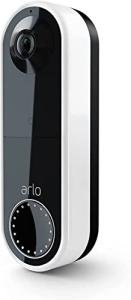

Technical specifications indicate the Arlo 2K (2nd Gen) utilizes a direct-to-Wi-Fi topology, removing the requirement for a mandatory base station. The primary image sensor captures a native 1944x1944 resolution at a 1:1 aspect ratio, optimized for vertical field-of-view coverage. The wireless chipset is limited to 802.11b/g/n (2.4GHz), which supports standard range through exterior cladding but may experience handshake latency during two-way audio sessions if signal strength drops below -65dBm. Structural analysis confirms a sealed polycarbonate housing with an IP65 weather-resistance rating.
System Interface Capabilities
- SIP Integration: Direct voice-call signaling for mobile notifications.
- Dual-Power Support: Functional via internal lithium-ion battery or 16-24V AC transformer.
- Package-Centric Optics: 180-degree field of view for doorstep monitoring.
Operational data suggests that while the unit supports battery-only mode, hardwiring to a constant power source minimizes trigger lag and wake-up delays. AI-driven person and package detection are processed via cloud-based algorithms, necessitating an active subscription for these specific metrics. In high-humidity environments, technical reports have noted occurrences of ghosting on the capacitive touch button interface. Local integration with NVR systems is restricted, requiring specific bridge hardware for non-cloud recording.
Stabilizing the exterior signal perimeter with high-performance mesh networking gear can prevent 2K video stream drops during peak usage.
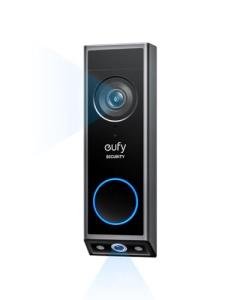
For users seeking a similar 2K resolution but wanting to avoid cloud-based subscription fees, the Eufy E340 offers local AI processing as an architectural alternative.
This device represents a high-resolution node within the wireless video doorbell systems market.