Maintaining the perfect moisture balance in a garden requires more than just guesswork. Modern technology now offers a way to monitor soil health in real-time, helping to prevent both underwatering and the dreaded root rot. This guide explores the most reliable sensors available, focusing on how different connection types and sensing technologies impact long-term gardening success.
Smart Soil Moisture Sensors
Keep your plants happy and healthy with smart soil moisture sensors that take the guesswork out of watering
Product List
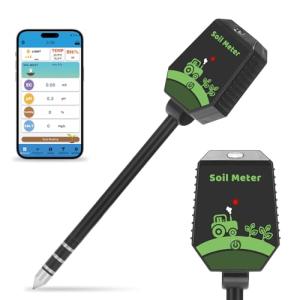
💡 Practical Usage Tips
- Performing a saturation test by watering a small area thoroughly helps set a reliable "100% wet" baseline for your specific soil type.
- Creating a small pilot hole with a screwdriver before inserting the sensor prevents damage to the protective coating on the probe.
- Placing sensors within 30 feet of a smart home hub or using a dedicated repeater ensures the signal remains strong through thick exterior walls.
- Checking the battery compartment seals during the initial setup ensures the device remains watertight during heavy rain or irrigation cycles.
✅ What to Look For & ⚠️ What to Avoid
Must-Haves for Long-Term Success:
- Devices using CAPACITIVE SENSING are preferred because they measure moisture without the metal probe touching the soil directly, which stops corrosion.
- Look for a ZIGBEE 3.0 protocol if local control and battery efficiency are priorities, such as with the Thirdreality Smart Soil Sensor.
- A high IP67 RATING is essential for any equipment that will be left outside in the elements year-round.
Red Flags to Watch Out For:
- Avoid sensors that rely purely on RESISTIVE PINS, as these often oxidize quickly and provide "stuck" or inaccurate readings after just a few months.
- Be cautious of WIFI-BASED PROBES if they do not have a solar panel, as the high power draw usually drains batteries in just a matter of weeks.
- Stay away from generic passive analog meters for automated systems, as they cannot send alerts to a phone or trigger irrigation timers.
🛡️ Build Quality & Performance
The durability of a soil sensor depends largely on its housing material and how the internal electronics are shielded. Top-tier models often utilize UV-RESISTANT ABS plastic to prevent the sun from making the casing brittle over time. While many sensors look similar on the surface, the weight and seal quality of the battery door usually reveal the true level of engineering. For instance, the Thirdreality 3-Pack features a fully encapsulated probe that protects the circuit board from the constant dampness of the earth.
Performance is also measured by how well a device handles signal interference. While SUB-GHZ RF signals travel much further through dense foliage, ZIGBEE models offer the best integration for users who want their sensors to talk directly to other smart home devices without relying on a manufacturer's cloud server.
🏆 Top Recommendations
| Best For | Model Name | Key Feature | Why It Wins |
|---|---|---|---|
| Smart Home Users | Thirdreality Zigbee | Zigbee 3.0 | Excellent local control and battery life. |
| Long-Range Use | Ecowitt WH51 | 915MHz RF | Signals reach up to 300 feet away. |
| Eco-Friendly | Netro Whisperer | Solar Powered | Eliminates the need for battery changes. |
| Budget Indoor | Rainpoint Indoor | 433MHz RF | Simple setup with great wall penetration. |
❓ Frequently Asked Questions
What is the difference between capacitive and resistive sensors?
Resistive sensors use exposed metal that corrodes over time as electricity passes through the soil. Capacitive sensors are encased in a protective layer, measuring moisture through an electric field without direct metal-to-soil contact, which makes them last much longer.
Do these sensors work in all types of soil?
While they work in most environments, very rocky soil or heavy clay can affect accuracy. It is often necessary to calibrate the sensor by comparing its "100% saturation" reading to a "completely dry" reading for your specific garden beds.
Can a smart sensor trigger my sprinklers automatically?
Yes, provided the sensor is connected to a compatible smart home hub. You can set a rule that tells your irrigation controller to turn on only when the soil moisture level drops below a certain percentage.
Would you like me to help you compare the specific range requirements for your garden layout or check compatibility with your existing smart home hub?