Enhancing a home theater experience often begins with the smooth, cinematic transition of a motorized display. These systems offer the convenience of hiding the screen when it is not in use, preserving the room's aesthetics while providing a professional-grade surface for movies and presentations at the touch of a button. Choosing the right model involves balancing motor reliability with surface quality.
Motorized Projector Screens
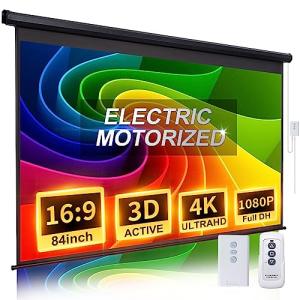
Experience effortless movie nights with our easy-to-use motorized projector screens
Product List
💡 Practical Usage Tips
- It is highly beneficial to allow a new screen to remain fully deployed for 48 to 72 hours to help the PVC material settle and release any initial manufacturing odors.
- To ensure the longevity of the motor, it is best to avoid cycling the screen up and down multiple times in a row, as this can trigger a Thermal Cut-off.
- Using a spirit level during the installation of the wall or ceiling brackets is essential to prevent the fabric from winding unevenly and developing permanent wrinkles.
✅ What to Look For & ⚠️ What to Avoid
Must-Haves:
- Look for a 1.1 Gain rating on the screen surface to ensure the image remains bright and clear even if the room is not perfectly dark.
- Seek out models like the AWOL Vision 120 that include a Scissor-Backed Tensioning system to keep the viewing surface completely flat.
- Ensure the unit features a high-opacity black backing to block any light coming from behind the screen, which keeps the picture from looking washed out.
Red Flags:
- Be cautious of Non-Tensioned designs in large sizes, as the edges of the fabric are highly likely to curl inward over several months of use.
- Avoid motors that produce excessive noise above 55dB, as this often indicates a lack of internal lubrication or lower-quality Synchronous Motor components.
- Watch out for units that lack a Vertical Limit Switch, which can lead to the motor trying to retract the screen too far and damaging the housing.
🛡️ Build Quality & Performance
The structural integrity of a motorized screen typically relies on a Steel Alloy or aluminum housing. A sturdy casing prevents the internal roller from bowing under the weight of the fabric, which is especially important for screens larger than 100 inches. Higher-end models utilize a Tubular Motor, which is hidden inside the roller itself to provide a quieter and more streamlined operation. These motors are generally rated for thousands of cycles, offering peace of mind for daily users.
Surface quality is the other half of the performance equation. Most standard screens use a multi-layer Matte White PVC that is designed to distribute light evenly across a wide viewing angle. While these surfaces are excellent for traditional projectors, those using ultra-short-throw projectors may need a specialized ALR (Ambient Light Rejecting) material. The Yodolla 120-Inch Motorized Screen provides a classic example of a robust steel-housed unit that balances weight and rigidity effectively for home environments.
🏆 Top Recommendations
| Best For | Model Name | Key Feature | Why It Wins |
|---|---|---|---|
| Premium Flatness | AWOL Vision 120 | Floor-Rising Scissor Lift | Active tensioning eliminates all wrinkles. |
| Humid Environments | Valerion 120 | IPX4 Waterproofing | Resists mildew and moisture damage. |
| Large Cinematic Span | Yodolla 150 | 150-Inch Surface | Massive scale for dedicated home theaters. |
| Compact Spaces | Kshioe 92 | 92-Inch Footprint | Fits easily into small rooms or apartments. |
❓ Frequently Asked Questions
Can these screens be used outdoors?
Most motorized screens are designed for indoor use only. However, specific models with an IPX4 rating, like the Valerion 120, are built to withstand moisture and are suitable for covered outdoor spaces.
What is "Gain" and why does it matter?
Gain is a measurement of light reflectivity. A 1.1 Gain means the screen reflects 10% more light than a standard white board, helping the image appear more vibrant without narrowing the viewing angle.
Why are the edges of my screen curling?
In non-tensioned screens, the PVC material can naturally contract or expand due to temperature changes. Without a Tab-Tensioning system to pull the fabric tight from the sides, the edges may eventually curl.