Breathing clean air is essential for good health, yet invisible pollutants often go unnoticed in our daily environments. Modern air quality alarms provide a crucial window into your home's atmosphere, tracking everything from carbon dioxide levels to microscopic dust particles. This guide breaks down complex sensor technology into clear, actionable advice to help you select the most reliable monitor for your safety and peace of mind.
Air Quality Alarms
Stay informed and breathe easy with smart alarms that keep your indoor air fresh and healthy
Product List
💡 Practical Usage Tips
- Most sensors require an initial calibration period outdoors or in a well-ventilated room to establish an accurate baseline for fresh air.
- It is best to place the monitor at breathing height in the room rather than on the floor or near a window, ensuring the readings reflect the air you actually inhale.
- While many units advertise internal batteries, these are often intended for short-term backup, so plan to keep the device plugged into a standard USB power source for continuous 24/7 monitoring.
- Regularly check the intake vents for dust buildup, as blocked airflow can significantly delay the detection of rising particulate matter levels.
✅ What to Look For & ⚠️ What to Avoid
MUST-HAVES:
- Look for devices that explicitly state they use an NDIR sensor (Non-Dispersive Infrared) for Carbon Dioxide, as this technology offers superior stability compared to electrochemical estimates.
- Prioritize models with active fan-based aspiration systems because they pull air across the sensors for faster updates, unlike passive designs that rely on slow ambient airflow.
- If you need data for home automation, choose a unit with confirmed Wi-Fi connectivity and app support, such as the Inkbirdplus 6-in-1.
- Ensure the display is a high-contrast VA or IPS panel if you intend to read the numbers from across the room.
RED FLAGS:
- Be cautious of "10-in-1" or "16-in-1" devices where metrics like "Oxygen" are mathematically calculated from other data points rather than measured by a real physical sensor.
- Avoid monitors that rely solely on a smartphone connection for alerts if you need immediate local safety warnings, as network latency can delay critical notifications.
- Watch out for units that claim portability but have very small batteries, as Wi-Fi transmission consumes significant power and will drain the device in just a few hours.
- Steer clear of sensors lacking a laser scattering module if your primary concern is tracking fine dust or smoke particles (PM2.5).
🛡️ Build Quality & Performance
The physical construction of air quality alarms varies significantly between portable spot-checkers and stationary desktop monitors. High-quality units generally utilize injection-molded ABS plastics with strategically placed vents to facilitate consistent airflow through the sensor chamber. Devices designed for continuous operation often include rubberized feet to prevent slipping and a weighted base to offset the pull of USB cables.
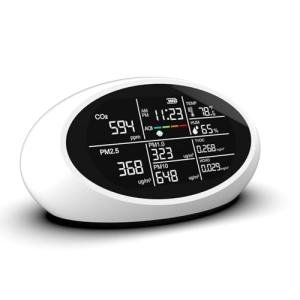
Performance in this category is defined by sensor responsiveness and data stability. Premium models incorporate internal fans to actively draw air in, which ensures that changes in air quality are detected in seconds rather than minutes. However, this active cooling can introduce a faint hum, which is something to consider for bedroom placement. The display technology also plays a major role in the user experience; for example, the Accunni Standalone Monitor features a large, color-coded screen that makes it easy to assess safety levels at a glance without needing to open a mobile app.
🏆 Top Recommendations
| Best For | Model Name | Key Feature | Why It Wins |
|---|---|---|---|
| Smart Home | GoveeLife Smart Monitor | Ecosystem Sync | Seamlessly triggers compatible purifiers via distributed gateway logic. |
| Standalone Safety | Morptra AQI Monitor | Hardware Alarms | Audible alerts function independently of Wi-Fi or internet outages. |
| Data Logging | Temtop M2000C | CSV Export | Semi-professional tool allowing historical data analysis on PC. |
| Ozone Detection | ZYKYCX Detector | Electrochemical Sensor | Specialized detection for hazardous O3 levels with fast response time. |
❓ Frequently Asked Questions
Why does the CO2 reading fluctuate so much?
Carbon dioxide levels naturally rise and fall based on room occupancy and ventilation. A sensitive NDIR sensor will detect immediate changes when a person breathes near the device, which is a sign that the monitor is working correctly and responding to the environment.
Do I really need to calibrate the device?
Yes, most sensors drift over time due to temperature changes and aging components. Performing a manual calibration in fresh outdoor air helps reset the sensor baseline, ensuring that the readings for indoor pollutants remain accurate and meaningful.
Can I use these monitors to detect gas leaks?
Generally, no. Most air quality monitors focus on particulates, CO2, and VOCs from household products. Unless the device specifically lists a sensor for natural gas or propane (explosive gases), it should not be relied upon for detecting fuel leaks.
Why is the battery life so short on some models?
Sensors that use Wi-Fi to transmit data to the cloud consume a significant amount of power. Additionally, active sensors that use fans and lasers require constant energy, meaning small internal batteries are often just for backup during power outages rather than for days of wireless use.